



Lifecycle Architecture for Journey Builder
Journey performance rarely declines because one individual journey was poorly built. The cause usually lies deeper. Many Salesforce Marketing Cloud organizations have multiple campaigns, triggers, segments, and nurture flows running, but no clear lifecycle architecture that determines when someone enters, when someone must be excluded, which journey takes priority, and how follow-up should align with the commercial stage of the customer or prospect. This creates an environment in which journeys function technically but work against one another strategically.
The problem becomes visible when organizations move from individual campaigns to structural journeys. At first, Journey Builder primarily appears to be a way to automate communications more intelligently. Teams build flows for downloads, events, onboarding, lead nurturing, reactivation, or customer communications. As the number of journeys grows, however, overlap begins to emerge. Contacts may be active in multiple flows at the same time, segments are interpreted differently, and commercial priorities are not always clear. Without lifecycle architecture, journey performance becomes unpredictable.
Why Individual Journey Flows Are Not Scalable
An individual journey can perform well as long as the target audience is clear, the trigger is precise, and the follow-up actions are limited. The problem arises when multiple journeys operate alongside one another without overarching lifecycle logic. A contact may simultaneously be included in a lead nurture, event follow-up, product interest flow, and reactivation campaign. Each journey may be defensible on its own, but together they create confusion. The customer or prospect does not experience consistent guidance, but an accumulation of disconnected marketing interactions.
This is particularly risky in a B2B context. The commercial stage of an account, the contact’s role, the sales status, previous interactions, consent, partner structure, and account value collectively determine what the logical next step should be. When Journey Builder is used only to build flows rather than structure lifecycle decisions, the organization continues to manage campaign activity instead of customer progression. A great deal may appear automated while the underlying customer logic remains fragmented. Journey performance then declines not because of insufficient tooling, but because of insufficient architecture.
Journey Builder only delivers structural value when journeys are not designed as isolated flows, but as part of a lifecycle architecture with clear entry, exclusion, priority, and follow-up rules.
From Campaign Thinking to Lifecycle Thinking
Many marketing organizations come from a campaign-driven mindset. There is an occasion, a target audience, a message, a channel, and a measurement point. That model is clear, but limited. A campaign focuses on a moment. A lifecycle considers the entire commercial relationship over time. For Salesforce Marketing Cloud, this means journeys should not only respond to a trigger, but must also fit within a broader customer stage. A download is therefore not automatically the starting point for nurturing, but a signal within an existing lifecycle context.
Lifecycle thinking requires marketing to ask not only which message is relevant now, but also which stage should take precedence. Is someone unknown, in an early research phase, actively interested, a Sales Accepted Lead, an opportunity contact, an existing customer, a partner contact, or a reactivation candidate? Each stage requires different communication, timing, and exclusions. Without this structure, journeys are built too heavily around marketing events. With lifecycle architecture, journeys are built around customer and account logic.
Entry as a Strategic Decision
Entry is one of the most underestimated aspects of journey performance. A journey is often initiated based on a form submission, list membership, campaign source, event attendance, or behavioral data. Technically, this makes sense, but strategically it is insufficient. Not everyone who meets a trigger condition should enter the same journey. An existing customer, an active opportunity, a partner contact, and a cold prospect may complete the same download, but they do not require the same follow-up.
Entry must therefore be treated as a strategic decision. The question is not only whether someone technically qualifies, but whether the journey fits the lifecycle status, commercial priority, consent context, and existing communication pressure. When entry criteria are too broad, journeys become unfocused and relevance declines. When they are too narrow, potential remains unused. A strong lifecycle architecture defines in advance which contact statuses, account contexts, and behavioral criteria are sufficient to justify entry.
Exclusion Prevents Journey Conflict
Exclusion is at least as important as entry. Many journeys include audience criteria but insufficient exclusion logic. As a result, contacts may enter flows that are no longer commercially appropriate. A prospect already being followed up by sales continues to receive marketing nurture communications. A customer receives prospect messaging. A contact who has just entered an event follow-up journey simultaneously enters a product interest flow. On paper, the journeys function correctly, but the overall experience becomes less relevant.
Exclusion should therefore not be treated as technical hygiene, but as part of commercial prioritization. The organization must determine which stages override other flows. Sales follow-up may, for example, take priority over general nurturing. Customer communications may exclude prospect flows. An active opportunity may block certain awareness campaigns. Consent changes must immediately affect channel activation. Without exclusion logic, journey contamination develops, resulting in more communication but less control.
Which Lifecycle Decisions Must Be Made in Advance
A lifecycle architecture does not need to begin as a complex model, but its most important decisions must be explicit. Otherwise, each team creates its own journey rules, eventually producing an environment that is difficult to manage. The foundation lies in defining decision logic for entry, exclusion, priority, and follow-up in advance:
- It must be established which lifecycle status takes precedence when a contact meets multiple journey triggers simultaneously.
- It must be determined which journeys take priority when marketing nurture, sales follow-up, event communications, and customer communications overlap.
- It must be clear which data is required to determine entry and exclusion reliably within Journey Builder and Salesforce CRM.
- It must be defined how follow-up is coordinated between marketing, sales, and any partners when a contact or account moves from one stage to another.
These decisions make journey performance easier to govern. Teams no longer need to determine what is logical separately for every journey, but operate within a shared lifecycle structure. This prevents performance from being evaluated only through open rates, clicks, or conversions per flow. The question becomes broader. Does this journey contribute to the appropriate movement within the lifecycle?
Priority as the Missing Layer in Journey Builder
Journey Builder makes it possible to create powerful flows, but priority does not emerge automatically from the tool. Priority is an organizational decision. When multiple journeys appear relevant at the same time, it must be clear which commercial logic carries more weight. An upsell opportunity involving an existing customer may be more important than a general newsletter. A Sales Accepted Lead may temporarily require less marketing pressure. A strategic account may require different follow-up from a low-value inbound lead.
Without a priority layer, journeys are optimized independently. Each team attempts to improve its own flow, but no one governs the total communication pressure or commercial sequence. Performance per journey may therefore appear reasonable while total lifecycle performance declines. A lifecycle architecture establishes priority. It determines which stage, customer value, sales status, account type, or consent context carries more weight when multiple journey options are available. This makes Journey Builder not only operational, but governable.
Real-Time Personalization Requires Lifecycle Context
Real-time personalization is often connected to current behavioral data. Someone visits a page, clicks an email, downloads content, or shows interest in a product. These signals can be valuable, but without lifecycle context they are quickly overestimated. Not every behavior represents the same intent. An existing customer viewing product information has a different context from an unknown prospect. A partner downloading content follows a different path from an end customer. A contact associated with an open opportunity requires a different interpretation from someone in an early research phase.
Real-time personalization therefore cannot be separated from lifecycle architecture. The current trigger must be combined with status, role, account relationship, consent, segment, and commercial priority. Only then does personalization become relevant and explainable. Without lifecycle context, marketing automation primarily responds quickly. With lifecycle context, it responds appropriately. That distinction determines whether personalization strengthens the customer journey or instead produces too many disconnected, situational communications.
Measuring Journey Performance Requires Different KPIs
When journeys are evaluated independently, teams often focus on metrics such as opens, clicks, form conversions, unsubscribe rates, and engagement. These figures can be useful, but they reveal little about lifecycle quality. A journey may generate high engagement while contributing little to stage progression. A campaign may produce many clicks, primarily from contacts that are no longer commercially relevant. A nurture flow may appear active while providing sales with few improved leads.
Lifecycle architecture therefore requires different KPIs. The main question is not only whether people respond, but whether they move through the lifecycle in the appropriate way. Are early-stage prospects being qualified more effectively? Are Sales Accepted Leads followed up more quickly? Are existing customers approached more relevantly? Is communication overlap decreasing? Is pipeline contribution being strengthened through journeys? These KPIs connect Journey Builder to commercial outcomes. Journey performance consequently becomes less operational and more governable.
Where Lifecycle Architecture Must Reside in the Salesforce Environment
Lifecycle architecture is not a standalone document placed beside Salesforce Marketing Cloud. It must be reflected in data, governance, Journey Builder, Account Engagement, CRM statuses, and reporting. Only then can the organization prevent teams from applying the same concepts differently. When lifecycle stages exist only in presentations, the operational environment continues to permit deviations. When lifecycle logic is translated into the architecture, entry, exclusion, priority, and follow-up become more enforceable.
| Lifecycle Layer | Governance Question | Risk Without Architecture | Translation into Salesforce Marketing Cloud |
|---|---|---|---|
| Entry | Who may enter which journey? | Contacts enter flows based on triggers without lifecycle context. | Entry criteria combine behavior, status, consent, and account context. |
| Exclusion | Which stage or status blocks certain communications? | Contacts receive overlapping or commercially inappropriate messages. | Exclusion rules prevent conflict between nurture, sales, and customer communications. |
| Priority | Which journey or follow-up action carries the most weight? | Teams optimize individual journeys rather than the total lifecycle. | Priority logic determines which flow takes precedence when overlap occurs. |
| Follow-Up | Who takes action when someone moves to a different stage? | Marketing, sales, and partners interpret signals differently. | Journey outcomes are connected to routing, CRM status, and reporting. |
These layers make lifecycle architecture practical. They connect Journey Builder to CRM data, sales alignment, consent management, and management reporting. This makes it clearer why performance declines when these layers are missing. The problem is not one email, one flow, or one trigger. The problem is the absence of a shared system that determines the appropriate next step.
The Relationship with Account Engagement in B2B
B2B organizations often use a combination of Salesforce Marketing Cloud and Account Engagement. Account Engagement is used for lead nurturing, forms, scoring, and sales-oriented follow-up. Salesforce Marketing Cloud is used for broader journeys, customer communications, and multichannel activation. When lifecycle architecture is absent, these environments can begin to overlap. A prospect may be active in an Account Engagement nurture while Marketing Cloud simultaneously activates a broader journey.
That is not necessarily wrong, but it requires a clear division of responsibilities. Account Engagement can be highly effective for B2B lead qualification and sales alignment, while Journey Builder supports the broader lifecycle and communication orchestration. The organization must determine which status, journey, or environment takes precedence during each stage. Without that decision, confusion emerges in communication, scoring, and reporting. With lifecycle architecture, Account Engagement and Journey Builder can reinforce one another.
Follow-Up Determines Whether Journeys Create Commercial Value
A journey does not end with the final email or the final decision split. Commercial value often emerges only during follow-up. This may involve a sales action, partner routing, an account update, a customer success signal, a retention action, or a new journey stage. When follow-up is not properly designed, journey performance remains limited to marketing interaction. A flow may then generate substantial engagement while changing little in pipeline, revenue, or customer value.
Follow-up must therefore be part of the lifecycle architecture. The organization must determine what happens when someone demonstrates sufficient intent, when someone disengages, when a customer stage changes, or when a contact is no longer eligible for activation. These decisions should not be made manually after the event. They must be supported by CRM statuses, routing rules, notifications, reporting fields, and clear responsibility between marketing and sales. Only then does Journey Builder become part of commercial governance.
Why Governance Is Required for Lifecycle Stability
Lifecycle architecture only continues to work when governance prevents teams from repeatedly creating their own variations. This is a genuine risk. Local teams want market-specific adjustments, campaign teams want speed, sales wants additional signals, and management wants more dashboards. Without governance, the lifecycle gradually becomes a collection of exceptions. Stages are applied differently, entry rules diverge, and journeys become difficult to compare.
Governance does not need to block local relevance. It must determine where adaptation is permitted and where consistency is required. Local content, timing, and emphasis may differ, while lifecycle statuses, exclusion rules, priority logic, and reporting fields remain centralized. This distinction is important. It enables scalability without reinventing customer logic for every market.
From Journey Optimization to Lifecycle Performance
The maturity step lies in shifting from journey optimization to lifecycle performance. Journey optimization evaluates the performance of a flow. Lifecycle performance evaluates the movement of contacts and accounts through the commercial process. This is a fundamental distinction. The first can produce better emails. The second produces better governance of marketing, sales, and customer communications.
For Salesforce Marketing Cloud organizations, this distinction is essential. As journeys increase in number and complexity, the need grows to determine why each journey exists, which stage it supports, which exclusions apply, and which follow-up actions are expected. Without lifecycle architecture, journeys become faster but not necessarily more intelligent. With lifecycle architecture, Journey Builder becomes an instrument for commercial progression rather than merely communication automation.
The central point is therefore that declining journey performance is often not a signal that more content, more triggers, or more automation is required. It is a signal that lifecycle architecture is absent or insufficiently explicit. Organizations that centrally design entry, exclusion, priority, and follow-up can improve journeys in a scalable way. Organizations that continue to work with isolated flows will increasingly discover that more automation creates less clarity.
Deep-Dive Topics within Salesforce Marketing Cloud:
Why Campaigns Create Too Much Noise Without Lifecycle Logic
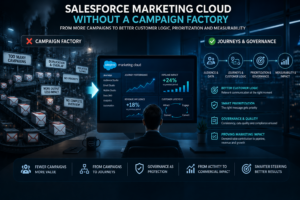
How to prevent Salesforce Marketing Cloud from becoming a campaign factory when journeys require clear direction, priority, and commercial context.
Why Journeys Require More Than Campaign Automation

How moving from isolated campaigns to journeys creates value when customer stages, timing, and follow-up are designed centrally.
Why Some B2B Journey Patterns Scale Better

How recognizable Journey Builder patterns make B2B journeys less ad hoc, easier to govern, and more commercially relevant.