


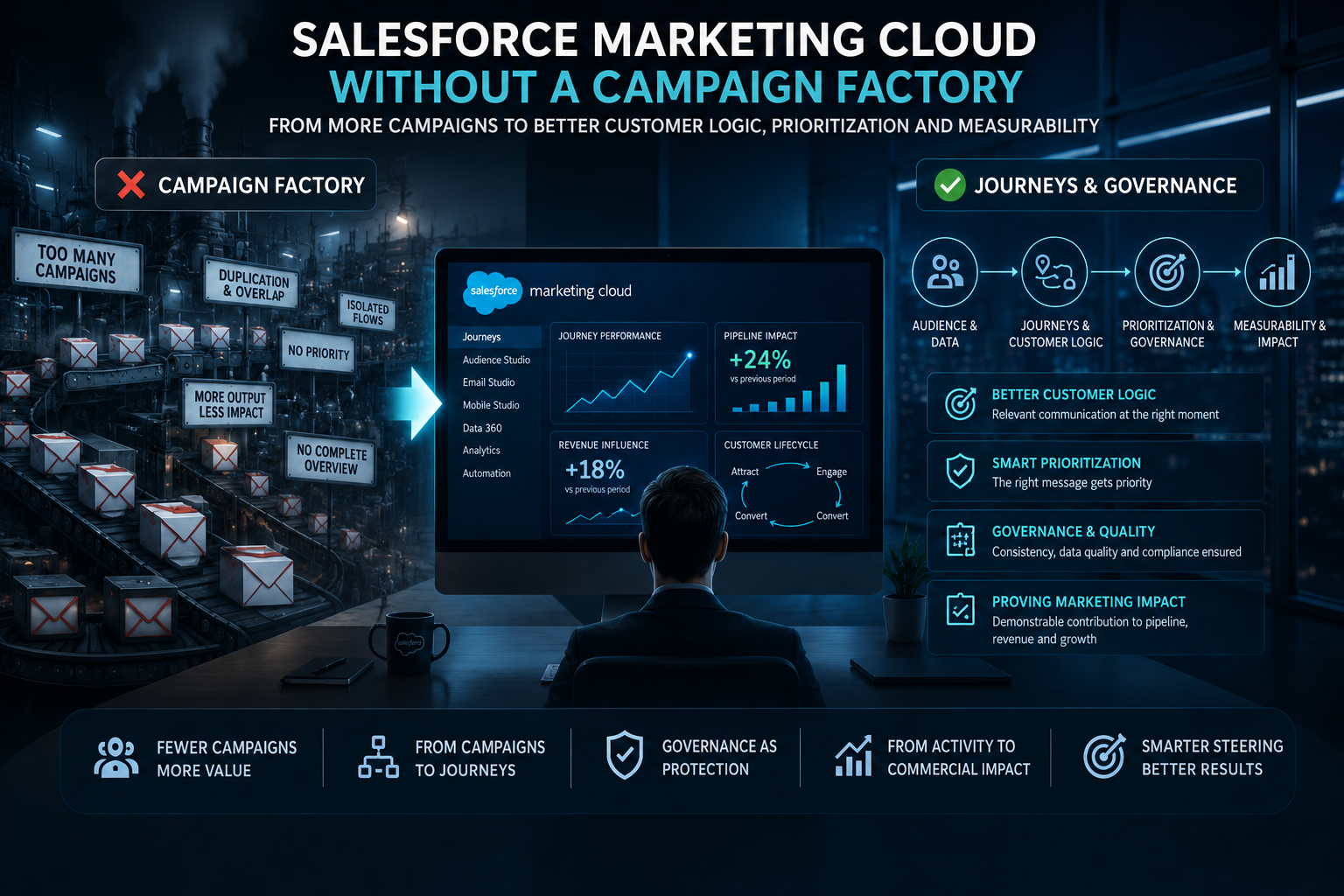
Salesforce Marketing Cloud Without a Campaign Factory
Salesforce Marketing Cloud is implemented in many organizations to make marketing smarter, more scalable, and more measurable. The expectation is that campaigns will be executed more professionally, journeys will become more relevant, and dashboards will provide greater clarity about marketing’s contribution to pipeline, revenue, and customer value. Over time, however, a different pattern often emerges. The platform is increasingly used to produce more campaigns faster, while the underlying customer logic, prioritization, and measurability fail to mature at the same pace. At that point, Salesforce Marketing Cloud gradually turns into a campaign factory. Teams build emails, segments, lists, triggers, automations, and dashboards, but increasingly lose sight of whether these activities contribute to better commercial decision-making. There is substantial output, but limited control. There are many campaigns, but insufficient lifecycle cohesion. There are many reports, but not always a clear view of marketing impact. The maturity step therefore does not lie in producing more campaigns, but in strengthening governance, journey logic, and measurability.Why More Campaigns Do Not Automatically Create More Value
Campaign volume feels like progress in many marketing organizations. More initiatives are running, teams respond faster to commercial requests, and local markets gain more opportunities to communicate with specific audiences. This can be valuable, but it does not guarantee better marketing performance. When every request from the organization is translated into a new campaign, the number of activities grows faster than the organization’s ability to safeguard quality, relevance, and impact. The core problem is that campaigns are often evaluated based on feasibility. Can the target audience be selected? Can the email be built? Can the journey go live? Can the dashboard display the results? These questions are operationally relevant, but strategically limited. A better question is whether the campaign fits the customer stage, whether it deserves priority over other communications, whether the data is sufficiently reliable, and whether the outcome reveals anything about commercial value. Without these questions, Salesforce Marketing Cloud primarily becomes a production environment.Salesforce Marketing Cloud only becomes strategically valuable when the platform is not used to produce more campaigns, but to enforce better customer logic, prioritization, and measurability.
The Transition from Campaigns to Journeys Is Often Underestimated
Many organizations say they are moving from campaigns to journeys, but continue to operate with a campaign-driven mindset in practice. A journey then becomes little more than a sequence of automated campaign interactions. There is a starting point, there are emails, decision splits, and measurement points. Yet this still does not constitute genuine journey architecture. A journey must determine not only which message comes next, but also why that message fits the lifecycle, commercial priority, and customer context. When campaigns are simply packaged into journeys, the format changes but the logic does not. Teams continue to think in terms of marketing occasions such as a webinar, download, product launch, event, newsletter, or retention initiative. Meanwhile, the customer experiences multiple flows that are not always aligned. Journey thinking requires marketing to begin with the question of which movement is needed in the customer relationship. Should someone be qualified, accelerated, excluded, handed over, reactivated, or temporarily left alone? Only after that decision should the campaign format follow.How a Campaign Factory Emerges
A campaign factory rarely emerges intentionally. It usually begins with good intentions. Marketing wants to support the organization more effectively, sales requests more leads, local teams want more market-specific initiatives, and management wants visibility into marketing activity. Salesforce Marketing Cloud makes faster delivery possible. As a result, the platform is increasingly treated as the answer to every communication request. The question shifts from “Should we do this?” to “How quickly can we launch it?” Over time, this creates structural pressure. Campaign calendars become crowded, segments overlap, journeys are modified without an overview of the lifecycle, and reports increase in volume without necessarily increasing in meaning. Teams remain busy building, checking, sending, measuring, and optimizing, but spend less time asking whether the overall system is improving. The campaign factory is therefore not a technical error, but an operating model problem. The platform does what it is asked to do, but the organization is no longer asking the right questions.The Hidden Costs of Campaign Production
More campaigns may appear productive in the short term, but they create hidden costs. Every campaign requires data, segmentation, content, validation, planning, reporting, and follow-up. When this process is insufficiently standardized, the management burden grows quickly. Marketing Operations then spends increasing amounts of time handling isolated requests, corrections, and exceptions. Data ownership becomes less clear because every campaign can introduce new interpretations of segments, fields, and target audiences. Costs also arise for sales and management. Sales receives more signals, but not necessarily better priorities. Management sees more dashboards, but not always better explanations. Customers and prospects receive more communications, but not necessarily more relevant guidance. Campaign volume can therefore begin to work against the organization. The platform remains active, but commercial clarity declines. The question is not how many campaigns Salesforce Marketing Cloud can process, but how many campaigns genuinely contribute to better customer management.Which Questions Must Be Asked Before Every Campaign
To prevent Salesforce Marketing Cloud from becoming a campaign factory, campaigns must be evaluated not only operationally, but also from a governance perspective. This requires a fixed decision point before production begins. The purpose is not to obstruct speed, but to prevent every isolated request from automatically becoming a new campaign. The following questions must therefore be asked consistently:- Does this campaign fit within an existing journey, lifecycle stage, or commercial priority, or does it create a separate communication stream alongside the existing model?
- Is it clear which audience is genuinely relevant, which contacts must be excluded, and which communication takes priority when this campaign overlaps with other journeys?
- Has success been defined in advance in terms of stage progression, pipeline, revenue, customer value, or sales follow-up rather than only opens or clicks?
- Is ownership assigned for follow-up, data quality, reporting, and any structural improvement resulting from this campaign?
Governance as Protection Against Marketing Pressure
Governance is often viewed as a control mechanism, but within a campaign factory it primarily protects teams against pressure. Marketing teams face constant pressure to deliver more. Without clear governance, it is difficult to reject additional campaigns, local exceptions, or new reporting requests. Salesforce Marketing Cloud makes execution possible, but governance determines whether that execution is also sensible. Strong governance clarifies which campaigns are managed centrally, which may be adapted locally, which data is authoritative, which segmentation frameworks apply, and which reporting structure must remain intact. In this way, governance protects the scalability of the platform. Local relevance remains possible, but not at the expense of data quality, lifecycle logic, or measurability. Governance does not slow marketing down. It is the layer that prevents speed from turning into fragmentation.Prioritization Determines Whether Journeys Reinforce One Another
One of the greatest risks of a campaign factory is that everything appears important. Every campaign has an owner, an objective, a deadline, and a justification. Customers and prospects, however, do not experience the organization’s internal priorities. They experience only the combined effect of all contact moments. Without prioritization, campaigns and journeys can weaken one another even when each has been executed well individually. Prioritization requires explicit rules. Active sales follow-up may take precedence over general nurturing. Existing customer communication may exclude prospect campaigns. A strategic account may receive different communication from a broad inbound lead. A consent change may immediately affect every channel choice. These are not minor details, but core governance decisions within Salesforce Marketing Cloud. Organizations that do not design priority allow the sequence of customer communication to be determined by campaign pressure and coincidental timing.Measurability Must Be Designed Before Production
Many marketing teams measure campaigns only after they have gone live. They review opens, clicks, form conversions, unsubscribes, and sometimes pipeline influence. This provides information, but not always evidence of marketing impact. When measurability is not designed in advance, the context needed to determine whether a campaign genuinely contributed to commercial value is missing later. Data may be available, but it cannot be translated into a decision. Measurability must therefore be part of the campaign decision. It must be clear in advance which movement the campaign is expected to create. Is the objective better lead qualification, acceleration toward sales, reactivation, customer retention, upsell, partner follow-up, or market validation? Each objective requires different measurement points. A campaign designed to develop early interest must be evaluated differently from a journey intended to accelerate Sales Accepted Leads. Salesforce Marketing Cloud can measure a great deal, but only governance determines which measurements are meaningful.Where Salesforce Marketing Cloud Must Govern Customer Logic
A mature Marketing Cloud environment shifts attention from campaign output to customer logic. This means the platform does not merely record what marketing sends, but also governs which communication fits the customer stage, channel preference, account context, commercial priority, and follow-up process. This logic must be reflected in segmentation, journeys, exclusions, contact frequency, reporting, and sales alignment.| Governance Layer | Campaign Factory Thinking | Customer Logic Thinking | Effect on Salesforce Marketing Cloud |
|---|---|---|---|
| Audience | Who can we reach with this campaign? | Who should receive this communication now within the lifecycle? | Segmentation becomes more relevant and less dependent on isolated lists. |
| Journey | Which flow should we build for this occasion? | Which stage, priority, and follow-up process does this journey support? | Journeys become part of a cohesive lifecycle architecture. |
| Governance | How can we launch this campaign quickly? | Which rules protect data quality, consent, priority, and measurability? | Campaign production remains scalable without contaminating the platform. |
| Reporting | How did this campaign perform? | Which commercial movement did this communication create? | Dashboarding shifts from activity to marketing impact. |
Why Dashboarding Can Conceal Activity
Dashboarding can unintentionally reinforce the campaign factory. When dashboards primarily display the number of campaigns, reach, clicks, opens, conversions, and engagement, more activity can quickly appear to represent progress. An increase in campaign volume becomes visible, while the quality of customer logic remains less visible. This makes it difficult to determine whether marketing is genuinely improving or simply becoming busier. For boardroom reporting, this is dangerous. Executives and C-level leaders do not need more activity without context. They want to know which marketing efforts contribute to pipeline, revenue, customer value, growth strategy, and capital allocation. This requires dashboards that show not only what marketing has done, but also why it was relevant and which commercial movement resulted. Proving marketing impact does not mean presenting more figures. It means connecting figures to decision-making.The Role of Marketing Operations in Preventing Campaign Factories
Marketing Operations plays a central role in preventing campaign factory behavior. Not by blocking every request, but by structuring intake, prioritization, release management, data quality, and reporting. Marketing Operations can ensure that campaigns are not built separately from lifecycle architecture, governance, and management reporting. This makes the function the practical connection between strategy and execution. That role requires authority. When Marketing Operations is responsible only for production, the team becomes part of the campaign factory. When Marketing Operations is also responsible for platform quality, release cadence, definitions, data quality, and adoption, the team can help the organization make better decisions. The difference lies in positioning. Marketing Operations must not only ensure campaigns go live, but must also be able to explain when a campaign is not the right solution.From Local Requests to Scalable Patterns
Local teams often have legitimate commercial requirements. They understand their market, customers, language, timing, and sales context better than central teams. The problem arises when every local requirement is translated into a unique campaign variation. Complexity then grows rapidly. Central teams lose visibility, reporting becomes less comparable, and the management burden increases. The answer, however, is not to eliminate local freedom. A better approach is to translate local requests into scalable patterns. A local event campaign can become part of a reusable event follow-up journey. A product interest campaign can be integrated into a broader lifecycle flow. A regional nurture requirement can be addressed through local content within central segmentation and reporting frameworks. Local relevance is preserved, but the architecture is not expanded with a new exception each time.When Fewer Campaigns Create More Impact
A paradox often emerges in mature Marketing Cloud organizations. Fewer campaigns can create more impact. This happens when campaigns are consolidated, journey logic is strengthened, segmentation is improved, and priorities become clearer. Customers then receive fewer disconnected communications, but more relevant guidance. Sales receives less noise, but stronger signals. Management sees fewer operational reports, but better explanations of commercial contribution. This requires discipline. Building an additional campaign is easier than critically restructuring existing communications. Yet that is often where the greatest improvement can be achieved. Salesforce Marketing Cloud becomes more powerful when the platform is not filled with ever more flows, but is structured around reusable patterns, clear lifecycle stages, reliable data, and measurable commercial outcomes. Less output can then create better control.The Governance Question Behind Every New Campaign
Behind every campaign request lies a governance question. Who decides whether this communication receives priority? Which data may be used? Which audience definition is authoritative? Which existing journeys are affected? Who owns the follow-up? Which KPIs determine success? And how will the organization prevent this campaign from remaining in the platform as an isolated exception? When these questions are not asked, governance becomes retrospective repair work. Teams only discover later that reports are not comparable, segments overlap, journeys interfere with one another, or sales interprets follow-up differently. By placing governance at the beginning of the campaign process, Salesforce Marketing Cloud becomes easier to manage. The platform then remains not only technically clean, but also commercially explainable.From Campaign Production to Commercial Decision-Making
The maturity step for Salesforce Marketing Cloud lies in moving from campaign production toward commercial decision-making. Campaigns remain necessary, but they are not the final objective. The objective is better customer management, stronger sales alignment, more reliable marketing impact, and clearer management information. This requires a different way of working. The organization must ask not only what can be built, but what will improve the overall system. For organizations seeking to grow with journeys, real-time personalization, Account Engagement, Data 360, AI, and Marketing Cloud Intelligence, this is essential. Every additional layer increases the temptation to activate more. But increased activation without stronger customer logic primarily increases complexity. Governance, prioritization, and measurability must therefore mature alongside ambition. Only then can the organization prevent Salesforce Marketing Cloud from becoming a campaign factory. The central principle is that value shifts from volume to quality. Marketing automation maturity is determined not by more campaigns, but by better decisions. Salesforce Marketing Cloud only creates sustainable value when campaigns become part of journeys, journeys become part of lifecycle logic, and reporting provides insight into commercial movement. The platform then becomes not a factory for marketing output, but a governable infrastructure for customer relationships, pipeline, and growth.Deep-Dive Topics within Salesforce Marketing Cloud:
Why Journey Performance
Declines Without Lifecycle Logic

How lifecycle architecture keeps campaigns aligned with customer stages, timing, and commercial follow-up.
Why Marketing Operations Makes Campaigns Governable

How marketing operations helps govern Salesforce Marketing Cloud as a mature commercial platform rather than using it primarily as an output machine.
Why Teams Need an Operating
Model for Growth

How clear roles, processes, and decision rights prevent campaigns from fragmenting across teams, markets, and ad hoc requests.