



From Lead Scoring to AI-Driven Sales Alignment: The Next Step for Account Engagement and Agentforce
Most multinational organizations already have sufficient technology to track prospects, automate campaigns, and report on sales opportunities. Yet the handoff between marketing and sales remains one of the most vulnerable stages in the B2B customer journey. Marketing delivers leads that the system considers ready for follow-up, while sales takes a different view of purchasing intent, account priority, or timing. The problem rarely lies exclusively in the scoring model. It arises when commercial definitions, customer context, and responsibilities are not aligned. With Salesforce Marketing Cloud Account Engagement and the emergence of Agentforce, the way organizations can address this challenge is changing. Existing scoring, grading, and nurturing capabilities can be connected with more advanced analytics and automated actions. However, an AI agent does not guarantee better lead quality, just as a high lead score does not automatically indicate an actual purchasing decision. The real strategic opportunity lies in a measurable, governable process in which marketing and sales interpret the same commercial signals consistently.Why a High Lead Score Does Not Necessarily Indicate a Sales Opportunity
A prospect may download multiple white papers, attend a webinar, and open several emails without having an active intention to invest. Another prospect may demonstrate very little campaign engagement but work for a strategic account where a project request is already underway. Traditional scoring models can explain these differences only partially, particularly when information about account developments or human sales interactions remains outside the marketing automation environment. Organizations that rely exclusively on engagement risk confusing interest with purchasing readiness. Account Engagement has long provided two relevant perspectives. Scoring reflects recorded interest and interactions, while grading evaluates how closely a prospect matches the desired profile. Both are valuable, but their effectiveness depends on configuration, data completeness, and the criteria selected. A high score without an appropriate account profile calls for a different next step than a strategically relevant prospect with limited recent activity.Sales Alignment Starts with Shared Definitions
Marketing cannot support a reliable sales pipeline when teams use different definitions of prospects, leads, MQLs, sales-accepted leads, and sales-qualified leads. The same applies to account status, buying group roles, and the reasons why a sales opportunity is returned to marketing. Without consistent definitions, the handoff becomes an administrative event rather than a substantive assessment. Ultimately, both departments lose confidence in the same dashboards. The solution is a jointly established qualification framework linked to the actual sales cycle. This includes an explicit service-level agreement: how quickly should sales evaluate a lead, which outcome must be recorded, and when should a contact return to a nurturing program? Commercial value emerges only when these rules are applied consistently and feedback is provided. A strong technical implementation supports this process but does not replace shared accountability.Sales alignment does not emerge when marketing hands over more leads, but when both departments recognize the same reasons to take the next commercial step.
From Individual Leads to Buying Groups and Account Context
In enterprise B2B sales processes, a major purchasing decision is rarely made independently by a single individual. The CFO evaluates financial implications, IT and security teams assess technical risks, procurement reviews contractual requirements, and the business unit considers operational value. One highly engaged contact therefore does not tell the complete story of a sales opportunity. Conversely, several modest signals from the same account may collectively reveal a more significant pattern than a single high individual score. For multinational organizations, the relevant question shifts from who clicked on a campaign to which organization may be engaged in a buying process and which decision-makers are involved. This requires reliable account relationships in Salesforce CRM, visibility into known contact roles, and coordination between marketing and account teams. Account Engagement can continue to support individual nurturing and engagement data, while account and opportunity context also comes from Sales Cloud and any additional data sources. Buying group insights emerge by combining this information intentionally, not by assigning every contact an undisclosed new score.What Einstein Behavior Scoring Actually Adds
With Einstein Behavior Scoring, Salesforce can analyze behavioral data and use patterns to assess engagement. Factors include the recency and frequency of activities. The score provides an additional signal beyond fixed, manually configured scoring rules. The functionality is not included by default in every Account Engagement edition; Salesforce specifies particular edition and Salesforce CRM requirements in its official configuration documentation. A predictive model also delivers convincing results only when the available historical data is relevant and reliable. For Behavior Scoring, Salesforce recommends a usable foundation of historical engagement data and opportunity relationships. Organizations should therefore not evaluate the model as though it can deliver perfect insights from day one. Scores must be compared with actual sales acceptance, opportunity progression, and conversion, and regularly assessed for differences across countries, segments, and products.Agentforce: From Insights to Executable Actions
The meaningful innovation is that Salesforce is not using AI exclusively for analytics or content generation. Agentforce can execute actions within the Salesforce environment, subject to configured boundaries. Specific Agentforce actions are available for Account Engagement, enabling an agent to view or update prospect records and add contacts to nurturing programs. Salesforce describes these capabilities in Using Agentforce with Account Engagement. The distinction between product functionality and implementation is important. The availability of an action does not mean that every Salesforce environment immediately has a fully autonomous marketing and sales agent. Agentforce must be configured, permissions and access must be appropriate, the required actions must be available, and usage may generate additional costs. Organizations must also determine which activities can be executed automatically and which require human approval before proceeding.Why the SDR Agent Requires Separate Consideration
Salesforce also describes an Agentforce Sales Development Representative agent that can answer product questions, address objections, and help schedule meetings. This goes beyond the specific Account Engagement actions available for prospect management. It would therefore be incorrect to suggest that every Account Engagement customer automatically gains access to a fully capable AI SDR simply by enabling Agentforce. The relevant product configuration, licensing, channels, and integrations must be verified separately. For commercial leadership, the key consideration is identifying when automated engagement actually creates value. An inbound inquiry received outside business hours may benefit from a fast, relevant response, provided the agent has access to approved product knowledge. For a strategic account involved in ongoing negotiations, however, unsolicited AI-driven outreach could be harmful. The optimal division of responsibilities between AI and human sales representatives must therefore be based on customer value, interaction context, and risk rather than an ambition to automate every conversation.Design a Process with Explicit Human Decision Points
Before an AI agent contacts a prospect, the organization must establish which data is available, what objective is being pursued, and which exceptions apply. This includes rules covering active opportunities, existing account relationships, opt-outs, sensitive subjects, and contacts already managed by an account executive. Without these safeguards, automation may conflict with existing commercial agreements. The right question is not whether the agent is technically capable of completing a task, but whether the organization can responsibly delegate that task. For an initial controlled implementation, I would explicitly incorporate four decision rules into the operating model. Marketing operations, sales management, IT, and the responsible privacy function should establish them jointly:- Eligibility: allow only contacts with sufficient data quality, appropriate context, and demonstrable communication permissions.
- Authorization: grant the agent access only to the data and actions necessary for the specific task.
- Escalation: transfer complex questions, strategic accounts, and uncertain responses to a human representative in a timely manner.
- Control: record significant actions and exceptions, and measure whether outcomes align with the agreed commercial objectives.
Which Metrics Should the CMO, CRO, and CFO Track Together?
An AI-driven sales funnel can easily generate impressive activity figures. However, the number of questions answered, automated interactions, or meetings scheduled is not sufficient to establish commercial value. The relevant outcome is whether qualified opportunities are developed faster, more consistently, and at an acceptable cost. This requires a measurement framework that begins with quality and ends with tangible sales results.The following indicators provide a shared starting point for marketing, sales, and finance. They do not replace financial analysis, but they prevent a pilot from being evaluated exclusively on automation volume. Importantly, each KPI should have an agreed definition, a baseline measurement, and an accountable owner established in advance.
| Measurement Area | Indicator | Management Question |
|---|---|---|
| Qualification | Percentage of leads accepted by sales, segmented by source and customer segment. | Are account teams receiving more relevant opportunities? |
| Speed | Time between a relevant buying signal, initial follow-up, and sales acceptance. | Is commercial response time actually improving? |
| Pipeline | Opportunity creation, stage progression, and pipeline value by cohort. | Does better follow-up produce measurable commercial progress? |
| Quality and Risk | Incorrect handoffs, escalations, complaints, and consent-related deviations. | Does automation remain manageable and customer-focused? |
| Economic Value | Total operating costs compared with incremental commercial revenue. | Is the investment financially justified? |
Why Data Quality Defines the Limits of AI
Agentforce can act responsibly only on the basis of the data and instructions it can access. When CRM records are outdated, contacts are associated with the wrong accounts, or lifecycle statuses contradict one another, those shortcomings become part of the automation process. AI may even increase the speed at which such errors become visible. Data quality is therefore not a preliminary cleanup initiative, but an ongoing commercial management responsibility. International organizations face particular risks because the same company may appear under multiple names, subsidiaries, or regional entities. An agent evaluating a prospect independently may overlook an existing relationship with another business unit. Conversely, a centralized account profile may unintentionally combine data from different countries without every intended use being justified. The quality of identity relationships, access permissions, and field definitions therefore directly determines which AI applications can responsibly be authorized.International Compliance Is Part of the Sales Experience
In AI-driven communication, attention often focuses on what an agent can say. For a multinational organization, it is equally important to determine when the company may contact a prospect and which personal data it may process for that purpose. Consent, lawful basis, channel preferences, objection records, and applicable national regulations must be evaluated before activation. Even when a message is composed or sent by an AI agent, the organization remains responsible for the processing of personal data and its commercial communications. The EU General Data Protection Regulation provides an important framework for European data processing, but international applications require additional analysis of local legislation and channel-specific requirements. SMS or WhatsApp functionality that can be used in one market may require additional registration or a different consent procedure in another. Sales and marketing must also communicate clearly when an interaction is automated, where legally required or appropriate for maintaining a responsible customer relationship. The guiding principle remains that transparency and controlled communication take precedence over maximum automation.An autonomous sales action creates value only when the organization can explain not just what happened, but also why that action was justified at that particular moment.
A Sound Pilot Starts with One Measurable Use Case
The best first step is not an agent that manages the entire international sales funnel. Begin with one clearly defined situation in which the problem is evident, such as inbound leads remaining unattended outside business hours or prospects who do not receive timely follow-up after a webinar. Ensure that the target audience, product involved, available data, and responsible sales representative are identified in advance. This makes it possible to compare performance with the existing process without disrupting the entire operation. A well-designed pilot includes a control or comparison group, clear acceptance criteria, and an agreed evaluation point. Assess not only the number of interactions, but also the substantive quality of responses, sales satisfaction, and progression toward opportunities. Have employees review exceptions and document which instructions or data sources influence the results. If the pilot does not deliver a demonstrable improvement, making adjustments or discontinuing it is also part of professional program management.The Operating Model Ultimately Determines the Return
The technological developments surrounding Account Engagement and Agentforce are significant, but their organizational implications extend far beyond a new feature in Salesforce Setup. Marketing operations must manage process definitions, sales must provide feedback on lead quality, and IT must ensure appropriate access, integration, and monitoring. Privacy and security specialists must be able to assess which data and actions are made available. Finance must then determine whether the outcomes justify the total costs. This does not require a permanent cycle of meetings, but it does require clear decision rights. Who is authorized to change a qualification threshold? Who approves new agent actions, and who can disable them when quality declines? Who decides when an account should be excluded from automated follow-up? As long as these responsibilities remain unclear, the problem shifts from human handoffs to technically automated ambiguity. For the CMO and CRO, this represents a shared leadership responsibility. They must establish agreement on the meaning of commercial signals and translate those agreements into processes that both people and systems can execute. A higher degree of automation is not an end in itself. The objective is a more reliable journey from initial interest to a qualified opportunity, with fewer unnecessary activities and better decisions.From More Leads to Better Commercial Decisions
The next stage of development for Account Engagement does not involve replacing scoring or Engagement Studio with an AI agent. Value emerges when existing automation, CRM context, predictive insights, and carefully selected Agentforce actions reinforce one another. Marketing can then deliver more relevant signals, sales can assess more quickly which opportunities genuinely deserve follow-up, and the commercial contribution becomes more measurable. The platform supports a shared process rather than two departments operating alongside each other. For multinational organizations, this means that AI investments must begin with data quality, shared definitions, and a specific business problem. These are followed by a limited pilot, measurable results, and only then broader automation. An organization that follows this sequence retains control over customer relationships, risks, and resources while exploring new capabilities. That represents a more sustainable competitive advantage than the promise that a digital sales colleague will independently fill the entire funnel. CloudEngagePro therefore approaches Account Engagement and Agentforce from the perspective of commercial logic, functional configuration, and measurable execution. The relevant question at the executive table is not how many tasks AI can take over, but which decisions become demonstrably better as a result. When marketing and sales answer that question together, AI becomes more than an isolated Salesforce experiment: it becomes a responsible extension of the existing commercial system.Deep-Dive Topics within Salesforce Marketing Cloud:
Why Lead Scoring Fails Without Buying Context

Traditional lead scoring often mistakes engagement for genuine buying intent. Discover how Account Engagement combines better qualification, account context, and commercial signals to produce more reliable leads and strengthen collaboration between marketing and sales.
How Lifecycle Governance Aligns Marketing and Sales
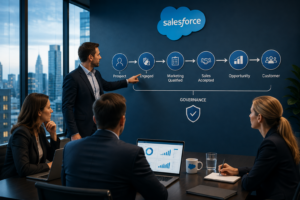
Effective sales alignment requires more than shared lead definitions. Discover how lifecycle governance in Account Engagement supports reliable qualification, clear handoffs, consistent follow-up, and stronger commercial decision-making across teams.
Why AI Agents Need Strong
Process Architecture

AI agents create sustainable commercial value when reliable data, clear decision rules, and human oversight work together. Discover how multinationals use AI responsibly within Salesforce Marketing Cloud and Account Engagement to improve lead prioritization and sales outcomes.