


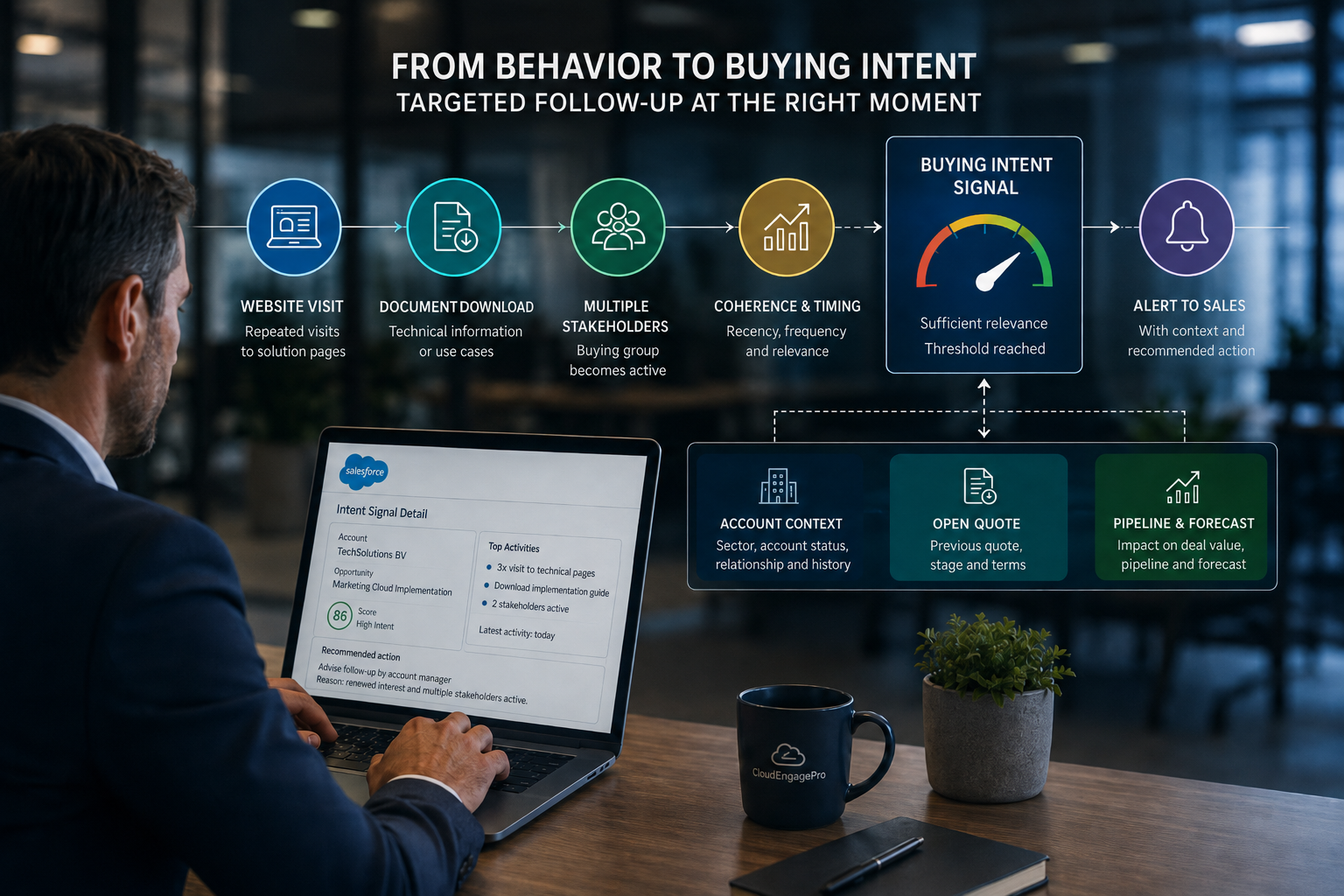
Buying Intent Signals for Targeted Quote Follow-Up
In long B2B sales cycles, the moment a quote is sent often says little about when a prospect actually becomes active again. A project may be postponed internally, a budget cycle may shift, or a technical assessment may be reopened months later. This makes it difficult for account managers to determine when follow-up is relevant and when additional contact may instead be perceived as unnecessary or intrusive.
Buying intent signals can improve that timing, but only when they are carefully designed. A website visit, an opened email, or a document download alone is not evidence that a purchase decision is getting closer. Commercial value emerges only when different signals are assessed together and connected to the context of the account, the opportunity, and the previous quote.
Effective sales support is therefore not about generating as many automated alerts as possible. It is about a limited number of signals that are sufficiently relevant, recent, and explainable to genuinely help an account manager. Salesforce can play a central role by bringing together behavior, account context, opportunity history, and follow-up logic.
Why a Single Quote Activity Says Little
A submitted quote marks an important commercial moment, but not necessarily the beginning of a short decision phase. In complex B2B processes, multiple teams, budget owners, technical specialists, and procurement stakeholders may be involved. As a result, the period between quote and order can vary considerably, and longer phases without visible activity can be entirely normal.
An account manager who looks only at the date of the latest quote often misses changes that occur later. The project may regain internal priority, a new stakeholder may start looking for technical information, or several people involved may simultaneously return to relevant pages. Such developments are usually more meaningful than the simple fact that a quote is still open.
An open quote represents a commercial opportunity; a coherent buying intent signal shows that the opportunity may be becoming relevant again.
Quote follow-up should therefore not be based solely on fixed time intervals. A standard task after seven or fourteen days can be useful for process discipline, but it says nothing about the prospect’s actual situation. Long sales cycles require a combination of scheduled follow-up and event-driven signals that indicate renewed commercial activity.
Engagement, Interest, and Buying Intent Are Not the Same
Many marketing and sales platforms use engagement as an umbrella term for virtually every digital interaction. A click, visit, download, or opened email then increases a score. That model can be useful for general lead qualification, but it is too broad for targeted quote follow-up with existing prospects and accounts.
Engagement means that someone is interacting. Interest means that the interaction is contextually related to a topic, solution, or project. Buying intent only emerges when behavior, timing, and commercial context together point to a possible next step in the purchasing process. This distinction matters because the same behavior can have a different meaning in different situations.
A visit to a general blog page, for example, may say very little. Repeated visits to technical documentation by several employees of an account that previously received a quote, on the other hand, may indicate a new internal assessment.
A useful buying intent signal should therefore contain at least four characteristics:
- The behavior is contextually related to a relevant solution, quote, or active opportunity.
- The signal is recent enough to suggest current commercial relevance.
- The frequency or combination makes coincidence less likely.
- The account manager can understand why the signal requires attention.
Without these characteristics, an alert remains primarily a technical event. Sales receives information, but no reliable reason to act.
From Traditional Lead Scoring to Revenue Signals
Traditional lead scoring often assigns points to profile characteristics and engagement. A job title, company size, form submission, and email click each contribute to a total score. Once a threshold is reached, the lead is passed to sales. This model primarily addresses whether a lead that has not yet been qualified is sufficiently interesting for initial follow-up.
Buying intent signals for existing prospects and open quotes answer a different question. Here, the relationship is already known, a commercial assessment has already taken place, and an opportunity may already exist. The challenge is not to determine whether the account is generally interesting, but whether there are indications that an existing sales process is starting to move again.
A revenue signal is therefore not simply an increase in a score. It is an explainable combination of behavior and context linked to a potential commercial consequence. Salesforce could, for example, recognize that a contact is downloading technical documentation again, that several colleagues from the same account are becoming active, and that a previous quote exists for a relevant product category.
The value does not lie in any one of these events individually, but in their relationship. The system then supports sales not with an abstract number, but with a concrete explanation: what behavior was observed, at which account, in relation to which opportunity, and why this moment may be relevant.
Which Signals Can Indicate Commercial Reactivation?
Not every signal has the same predictive value. Returning website visits may indicate renewed interest, but they can also reflect general research. A document download may support a technical assessment, but it may also come from someone without a direct decision-making role. Each signal therefore needs to be assessed within the broader account context.
Technical pages, product configurations, implementation documentation, pricing information, and specific use cases are generally more relevant than general company or news pages. The sequence of interactions can also be meaningful. When a contact first visits a product page, then downloads technical documentation, and subsequently a colleague from the same organization becomes active, a stronger pattern emerges than from three isolated visits spread over several months.
Isolated Engagement or a Useful Revenue Signal?
The same digital action can be noise in one situation and valuable commercial context in another. The table below shows why an isolated engagement signal is not automatically sufficient for sales action.
| Signal | Sufficient on Its Own? | Potential Commercial Meaning |
|---|---|---|
| One website visit | No | General research or an incidental return visit |
| Repeated visits to technical pages | Possibly | A previously discussed project may be becoming relevant again |
| Download after a previous quote | Strong signal | New internal assessment or preparation for decision-making |
| Multiple stakeholders from the same account | Strong signal | A buying group is becoming active again |
| Activity without a recent opportunity | Context required | New need, general research, or unrelated investigation |
Combining Contact, Account, and Opportunity Levels
A significant risk with digital signals is that all activity is assessed at the contact level. In complex purchasing processes, however, one person rarely represents the entire buying group. A technical specialist may review documentation, a manager may assess a business case, and procurement may later request pricing or contract information.
When Salesforce displays these interactions only as separate contact activities, the account manager misses the broader pattern. By aggregating signals at the account level as well, it becomes visible when several stakeholders within the same organization become active within a short period. That can be a stronger indication than intensive behavior from a single individual.
Opportunity context adds a third layer. Activity becomes more relevant when an open or previously lost opportunity exists that aligns with the pages being visited or the documents being downloaded. A prospect who starts reviewing information again about exactly the same solution covered by a previous quote requires a different assessment from a contact viewing general content without a recent commercial process.
A mature model therefore combines three perspectives. The contact level shows who is active. The account level shows whether multiple stakeholders and signals are converging. The opportunity level explains which commercial context already exists. Only when these layers are evaluated together does a useful revenue signal emerge.
Recency, Frequency, and Coherence Determine Signal Strength
A buying intent signal must be sufficiently recent. Activity from six months ago should not carry the same weight as behavior from yesterday. The relevant time period varies by sales model, but the principle remains the same: the older a signal becomes, the less it says about current buying intent.
Frequency helps distinguish incidental behavior from a pattern. One visit may be coincidental. Multiple visits to related pages within a short period are harder to dismiss as noise. However, frequency should not be accumulated without limits. Ten visits by the same person during a single session do not automatically represent ten separate commercial signals.
Coherence is often the strongest factor. A website visit, a download, and new activity from a second contact may collectively mean more than the individual events. The model should therefore not simply add points, but also recognize combinations. A sequence of contextually related signals within a limited period deserves more attention than a collection of isolated interactions without a clear relationship.
Recency, frequency, and coherence must also align with the normal sales cycle. In a market where decisions are made within a few weeks, a signal becomes outdated quickly. In project-based sales with lead times of many months, a longer time window may be appropriate. The logic should therefore be designed around the commercial process rather than a generic default setting.
Thresholds Prevent Alert Fatigue
When every relevant activity immediately generates a task or alert, sales teams quickly become overwhelmed. Account managers then learn that many notifications have little meaning and begin ignoring strong signals as well. The number of alerts increases while their actual value to sales decreases.
Thresholds determine when a combination of signals is strong enough to justify action. That threshold can be based on a minimum score, but also on required combinations. For example, an alert might only be generated when recent technical interest coincides with an open opportunity, or when multiple contacts from the same account become active within a short period.
A strong signal model does not only reduce noise; it also protects sales attention for the moments when follow-up can genuinely make a difference.
Thresholds should be evaluated after implementation. If almost every signal is followed up but produces little commercial progress, the threshold is probably too low. If won deals rarely show preceding signals, the configuration may be too restrictive or relevant data sources may be missing.
Suppressing Irrelevant and Explainable Activity
Not all activity from a known account comes from an active buyer. Employees may use documentation for administration, support, training, or general knowledge. Internal users, partners, job applicants, and suppliers may also generate website behavior that technically resembles buying intent.
Exclusion rules should therefore be part of the signal logic. Known internal domains, test accounts, support contacts, and existing customers displaying service-only behavior can be treated differently. Repeated downloads of the same document within a short period also do not need to count as a new signal every time.
Activity may also be explainable within an ongoing process. If an account manager has just sent documentation and the prospect opens it immediately, that confirms engagement but does not necessarily represent an unexpected moment that requires additional contact. The context of sent emails, scheduled meetings, and recent tasks helps suppress such alerts.
A useful model therefore considers not only what is happening, but also what is already known and planned. This prevents Salesforce from alerting an account manager about behavior they caused themselves or are already actively managing.
A Signal Should Explain Why Action Is Appropriate
An alert such as “buying intent increased” is too abstract. The account manager needs to see which events triggered the signal, how recent they are, and which opportunity or quote they are connected to. Without that explanation, the system remains a black box and users are unlikely to trust its output.
The context can be presented concisely. Salesforce could, for example, show that two contacts from the same account reviewed technical documentation within three days, that one contact downloaded a product specification, and that an open quote exists for the same solution. This immediately makes clear why the account deserves attention.
The recommended next step should also fit the situation. Not every signal requires a sales call. Sometimes a short, relevant email is more appropriate. In other cases, the account manager may first want to check internally whether a colleague has had recent contact. The system should support assessment rather than automatically forcing a standard response.
Explainability is also important for optimization. When users can indicate whether a signal was relevant, that feedback can be used to improve thresholds, combinations, and exclusions. The model can then develop based on real-world use rather than theoretical assumptions alone.
Connecting Quote Follow-Up to Pipeline Quality
Targeted signaling helps not only with timing, but also with pipeline quality. Open opportunities sometimes remain active in Salesforce for too long because it is unclear whether the sales process is genuinely still alive. Buying intent signals can provide additional indications, but they should not be used to compensate for a lack of sales discipline.
An opportunity without activity and without relevant signals requires reassessment. This does not automatically mean that the opportunity is lost, but it does mean that the expected close date, stage, and next step should be reviewed. Otherwise, the pipeline remains filled with opportunities that have little current evidence supporting them.
Conversely, renewed account activity may be a reason to reassess a previously postponed opportunity. When the behavior aligns with the previous quote and multiple stakeholders become active, the commercial opportunity may become more relevant again. The account manager ultimately determines whether the opportunity should be reopened or adjusted.
The signal model therefore supports a more realistic pipeline view. It makes both inactivity and reactivation more visible and helps sales assess opportunities based on current context.
The Relationship with Forecasting
Forecasting becomes unreliable when opportunity stages and expected close dates do not reflect actual commercial movement. Buying intent signals can supplement that information, but they do not replace sales judgment. Strong digital activity does not prove that an order will be placed.
The value lies primarily in identifying deviations. An opportunity at an advanced stage without recent interaction may require additional attention. A sales process with a later expected close date but suddenly strong account activity may warrant earlier reassessment. This creates signals that can provide more substance to forecast discussions.
Historical analysis can then show which signals more frequently preceded progress, postponement, or loss. These patterns can be used to refine the model and provide management with greater insight into pipeline health. It must remain clear, however, that correlation does not automatically imply causation.
A strong forecast combines system data, account activity, and human judgment. Salesforce can bring the relevant context together, but commercial interpretation still depends on knowledge of the customer, market, and project.
A Manageable Signal Model in Salesforce
Implementation does not begin by connecting as many data sources as possible. The first step is to determine which commercial situations sales wants to identify more effectively. These may include renewed activity after a quote, an active buying group within an existing account, or technical interest related to a previously lost opportunity.
Only then should signals be selected that can reliably support those situations. For each signal, it should be determined at which level it is stored, how long it remains relevant, and which combination is required before a task, alert, or dashboard entry is generated.
Ownership is essential. Marketing operations can manage behavioral data and definitions. Sales operations can determine which actions and opportunity context are required. Account managers provide feedback on relevance. Data and system owners safeguard quality, privacy, integrations, and technical operation.
The model should be reviewed periodically. New content, changes to products, and different sales processes can alter the meaning of signals. Without active management, the logic develops into a collection of exceptions and once again loses its predictive value.
From Alerts to Targeted Commercial Support
Buying intent signals only create value when they improve the timing and quality of quote follow-up. The objective is not to make every digital behavior visible, but to alert account managers to moments when an existing commercial relationship may be becoming relevant again.
To achieve this, engagement, interest, and buying intent must be clearly distinguished from one another. Signals must be recent, coherent, and connected to contact, account, and opportunity context. Thresholds and exclusion rules reduce noise, while a clear explanation shows why follow-up may be appropriate.
Salesforce therefore does not become an automated decision-maker, but a context layer that supports account managers. The platform brings together behavior, previous quotes, buying groups, and pipeline information and makes relevant changes visible without contacting prospects unnecessarily.
The best signal models therefore do not produce the most alerts. They build trust because a limited number of alerts are contextually accurate, explainable, and aligned with the actual commercial process. This makes quote follow-up more targeted, keeps the pipeline more realistic, and gives forecasting a stronger foundation.
Deep-Dive Topics within Salesforce Marketing Cloud:
Why Revenue Signals Provide Better Context Than MQLs

See how behavioral data, account context, and commercial timing combine to create stronger buying signals and support more relevant sales follow-up.
Why Lifecycle Architecture Supports Targeted Follow-Up

Learn how lifecycle stages, timing, and handoff rules help Marketing and Sales determine when follow-up is commercially relevant—and when it is not.
Why Revenue Operations Connects Signals to Revenue

Explore how Salesforce can connect buying intent, opportunities, quote follow-up, and revenue data so commercial teams can act on one consistent view.