



Data 360 for Usable Customer Profiles in Marketing Automation
Many organizations have more customer data than ever, but fewer usable customer profiles than they expect. Data is distributed across Salesforce, marketing automation, website forms, advertising channels, service processes, commerce environments, events, and external data sources. In dashboards, this appears to be a wealth of information, but in practice it often results in fragmentation. Marketing teams can build segments, sales can view customer information, and management can open reports, but the question remains whether everyone is actually looking at the same customer, the same status, and the same commercial context. This is where the value of Data 360 emerges. Not as a magical solution to every data problem, but as an architecture layer that can connect, harmonize, and make fragmented customer data usable for marketing automation. The strategic question is not whether an organization has enough data. The question is whether that data is clean, traceable, current, and meaningful enough to reliably support personalization, segmentation, lead qualification, journey orchestration, and management reporting. Without that foundation, marketing automation remains dependent on fragments rather than profiles.Why Fragmented Customer Data Weakens Marketing Automation
Marketing automation is often configured around campaigns, journeys, and conversion objectives. Teams want to send relevant emails, follow up on leads faster, recognize behavior, refine segments, and demonstrate contribution to pipeline. That seems logical, but the process then starts too late. When the underlying customer data is fragmented, every automation becomes vulnerable. A journey may be configured correctly from a technical perspective, yet still activate the wrong contacts. A lead score may be mathematically correct, yet commercially weak because important context is missing. A segment may appear large, yet have little value because profiles are duplicated, outdated, or incomplete. The problem usually does not reside in one system. It arises precisely because multiple systems each contain part of the truth. Salesforce contains account and opportunity information, Account Engagement contains engagement and form behavior, Marketing Cloud contains campaign and journey data, advertising platforms contain source information, and service processes contain customer interactions that marketing often does not fully see. As long as this information is not brought together in usable profiles, marketing automation continues to operate on technical availability instead of commercial relevance.Data 360 only adds value when it not only brings data together, but creates customer profiles that are usable for segmentation, personalization, governance, and commercial decision-making.
The Limitation of Single Source of Truth Thinking
Single source of truth sounds attractive, but it is often interpreted too absolutely in marketing organizations. Organizations search for one place where all truth resides, while customer data is in reality dynamic, context-dependent, and process-driven. An email address may be technically correct, but commercially unusable without consent. A lead may be active on the website, but not yet demonstrate buying intent. A customer may have generated revenue, but still be treated as a prospect in another business unit. The challenge is therefore not only to centralize data, but above all to determine which data is leading in which context. Single source of truth must therefore be translated into a governable data model. Data 360 can help harmonize customer data from different sources, but the organization must first determine which definitions, identities, relationships, and priorities matter. Without those choices, a technically merged profile emerges that still remains unclear to marketing, sales, and management. A usable profile requires not only connection, but also decision logic. Only then does it become clear which signals are reliable enough for activation and which signals should serve only as context.From Data Collection to Profile Creation
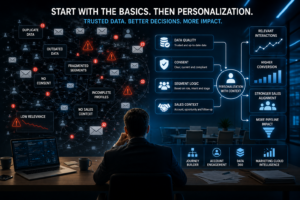
An important distinction exists between collecting data and creating profiles. Data collection means that events, fields, transactions, and interactions are made available. Profile creation means that these separate elements are connected into recognizable commercial context. For marketing automation, that difference is significant. A download, website visit, webinar registration, email click, and sales conversation are separate signals. Only when they are linked to the same person, the same account, the same lifecycle status, and the same commercial stage does a profile emerge that is usable for segmentation and personalization. Data 360 can add value precisely in that transition. It helps not only to place different data sources next to one another, but to harmonize them around customer identity, profile attributes, and behavior. This makes it possible to base marketing decisions on a more complete picture. Yet the quality of the outcome remains dependent on the choices made beforehand. When identity resolution, data quality, consent, account structures, and lifecycle definitions are configured weakly, the composite profile will also be weak. Data 360 then mainly increases the visibility of existing inconsistencies.Which Data Questions Must Be Answered in Advance
Before Data 360 adds value to marketing automation, it must be clear which questions the profile needs to answer. Otherwise, the project becomes technical too quickly. Teams then start connecting sources without having clearly defined which commercial decisions need to improve. A mature data model therefore begins with decision-making, not integration. The most important questions must be made explicit in advance:- Which identity is leading when the same person appears as a prospect, contact, customer, event participant, and website visitor.
- Which profile attributes are necessary for segmentation, personalization, lead qualification, and sales follow-up.
- Which behavioral data may be used for real-time personalization, AI models, and commercial prioritization.
- Which data must become visible in dashboards to reliably assess marketing contribution to pipeline, revenue, and capital allocation.
Clean Data as a Requirement for AI Personalization
AI personalization sounds powerful, but it depends on the quality of the profiles on which it runs. When customer data is duplicated, outdated, contradictory, or incomplete, AI models do not become smarter, but more unpredictable. A model may recognize buying intent based on behavior, but draw the wrong conclusions when that behavior is not linked to the correct account. A recommendation may appear relevant, but produce the wrong commercial outcome when lifecycle status, customer value, or consent context is missing. Data 360 should therefore not be viewed as an accelerator for AI before the foundation is in place. It is rather a way to strengthen the conditions for responsible use of AI. Clean data, clear profiles, explainable segments, and validated data flows make personalization more reliable. AI can then recognize patterns within a consistent context. Without that context, AI mainly amplifies existing noise. That is risky for marketing automation, because errors do not remain confined to analyses, but can directly affect journeys, offers, sales actions, and customer communication.Usable Segmentation Requires More Than Filters
Segmentation is still treated as filter work in many marketing teams. Selections are made by country, industry, job title, interest, score, campaign source, or engagement. That can be operationally useful, but it does not automatically produce usable segments. A usable segment is not only technically selectable, but also commercially interpretable. It must be clear why a group is relevant, which need or stage it represents, which journey is logical, and how success is measured. Data 360 can strengthen segmentation because more context becomes available. A segment then does not have to be based only on one form or one click, but can take account data, previous interactions, service history, commercial status, channel preferences, and engagement across multiple touchpoints into account. This makes segmentation more valuable, but only when the organization prevents segments from becoming too complex or too opaque. The richer the profile, the more important decision logic becomes. Otherwise, segmentation emerges that appears technically refined, but is difficult to explain to sales and management.Where Data 360 Adds Value in the Marketing Architecture
Data 360 should not stand separately alongside Salesforce Marketing Cloud or Account Engagement. Its value emerges when it becomes part of the broader marketing architecture. This means aligning customer profiles, segments, journeys, consent, lead qualification, and reporting. When Data 360 is used only as a technical data layer, its impact remains limited. When it is connected to commercial decision-making, it becomes a foundation for scalable marketing automation.| Architecture Layer | Data Question | Risk Without Profile Creation | Value of Data 360 |
|---|---|---|---|
| Customer identity | Which person, contact, prospect, or customer belongs to which profile? | Duplicate or fragmented profiles lead to inconsistent activation. | Identities are connected more effectively into a usable customer view. |
| Segmentation | Which groups are commercially relevant and current enough for activation? | Segments are technically correct, but substantively weak or difficult to explain. | Segments can be based on broader context and better data quality. |
| Personalization | Which signals may and can be used for relevant customer communication? | Personalization is based on isolated behavioral data without sufficient context. | Profiles support more explainable and scalable personalization. |
| Reporting | Which data explains contribution to pipeline, revenue, and commercial priority? | Dashboards show activity, but insufficient profile and customer value context. | Management reporting can be connected to customer profiles and commercial outcomes. |
The Role of Governance in Customer Profiles
Usable customer profiles do not emerge automatically from technical connections. They require governance. Someone must determine which source is leading, how conflicting data is resolved, which fields are mandatory, which data may be activated, and how quality is controlled. Without governance, Data 360 becomes a powerful platform with unclear decision rights. Teams may then see more data, but continue to debate interpretation, reliability, and ownership. Governance is particularly important when multiple countries, business units, or product lines serve the same customers. A contact may be a prospect in one country, a customer in another country, and part of a strategic account at group level. If this context is not governed properly, marketing automation may assign the wrong priorities. Governance ensures that profiles are not only complete, but also used consistently. This is essential for scalable personalization and reliable reporting to executive leadership.Why Dashboards Without Profile Context Fall Short
Dashboards often measure campaigns, channels, conversions, and pipeline. That is valuable, but without profile context, the analysis remains limited. A campaign may generate many leads, but mainly from profiles with low strategic value. A journey may show high engagement, but have little impact on accounts with genuine buying intent. A channel may generate inexpensive traffic, but contribute little to segments that sales actually wants to follow up on. Without customer profiles, marketing impact is too quickly assessed on volume rather than value. Data 360 can help make dashboards richer and more governable. Not by simply adding more charts, but by connecting marketing results to profile quality, customer value, lifecycle stage, account context, and commercial outcomes. For C-level and executive leadership, that difference is important. They do not only want to know how many campaigns have run or how many leads have been generated. They want to know which customer groups are growing, which segments convert, which markets deserve priority, and where marketing investments contribute to pipeline, revenue, and growth strategy.Data 360 as a Bridge Between Marketing and Sales
One of the greatest benefits of usable customer profiles is better alignment between marketing and sales. Sales often distrusts marketing data when leads are transferred based on limited signals. A score or engagement level says little when the underlying customer context is unclear. Marketing, in turn, often sees sales interpreting follow-up differently than intended. That difference is created not only by process agreements, but also by profile quality. When Data 360 helps connect engagement, account information, lifecycle status, channel interaction, and commercial history more effectively, the transfer to sales becomes stronger. A lead is then not merely someone who clicked or completed a form, but part of a broader profile with context. This makes lead qualification more explainable. Sales can better understand why a lead is relevant, marketing can better assess which signals truly contribute to conversion, and management can see how profile quality affects pipeline.From Data Project to Marketing Operating Model
The most important mistake is to treat Data 360 exclusively as a data project. Integrations, data models, identity resolution, and technical configuration are of course important. But the value for marketing automation only emerges when this technical layer is connected to the operating model. Who manages profile definitions? Who validates segment quality? Who determines when a signal is strong enough for personalization or sales follow-up? Who translates profile insights into boardroom reporting? These questions determine whether Data 360 is actually used or merely available. An organization may technically possess richer customer profiles, but still continue to run campaigns as if only separate lists existed. The implementation of Data 360 must therefore always be connected to processes, roles, and decision rights. Marketing operations plays a central role in this. This function can ensure that profiles are not only created, but also used consistently in journeys, segmentation, lead qualification, and reporting.From Fragmented Customer Data to Commercial Decision-Readiness
The maturity step does not lie in more data, but in better decision-readiness. Fragmented customer data only has value when it is converted into profiles that marketing, sales, and management can understand in the same way. Data 360 can support that step by harmonizing customer data, strengthening profile creation, and connecting activation more effectively to commercial context. But success depends on whether the organization determines in advance which profiles are needed, which data is reliable enough, and which decision-making must be supported by it. For Salesforce Marketing Cloud organizations, that is essential. Marketing automation is becoming increasingly dependent on real-time personalization, AI, journey orchestration, and revenue attribution. All of these components require customer profiles that are clean, explainable, and governable. When Data 360 is embedded properly, a foundation emerges on which segmentation becomes more relevant, personalization becomes more reliable, and dashboards say more about commercial value. When that embedding is absent, Data 360 remains primarily an additional data layer on top of existing complexity. The real value of Data 360 therefore does not lie in collecting everything that is available. The value lies in creating usable profiles that give direction to marketing automation. This moves the organization from fragmented customer data to commercial decision-readiness. It makes Salesforce Marketing Cloud not only richer in data, but stronger in governance, more relevant to sales, and more understandable to the boardroom.Deep-Dive Topics within Salesforce Marketing Cloud:
Why Data 360 Needs Strong
Customer Data Ownership

How clear data ownership prevents customer profiles in Data 360 from appearing technically complete while remaining commercially unreliable.
Why Customer Profiles Need More
Than a Single Source of Truth

How usable customer profiles depend on governance, shared business definitions, and decision logic—not merely centralized data.
Why Trusted Customer Data Makes
Personalization Reliable
How to prevent B2B personalization from relying on incomplete customer profiles, inaccurate segments, and customer data that is not yet operationally reliable.