



Lead Nurturing as a System, Not a Campaign
Lead nurturing is still treated in many organizations as a series of campaigns designed to move prospects step by step through a funnel. That model works as long as volumes remain limited, one team determines the rules, and exceptions can be resolved manually. In enterprise environments, the situation changes fundamentally. Multiple markets, Sales structures, data sources, and compliance requirements make nurturing dependent on far more than content and timing. Once those dependencies are not explicitly designed, a process emerges that continues to run technically but becomes increasingly difficult to trust commercially.
Salesforce Account Engagement provides sufficient functionality to organize nurturing at scale, but the technology does not automatically create a governable model. The central question is not how many emails, steps, or automation rules are built, but how behavior, profile, account context, and Sales information are interpreted together. Nurturing thereby becomes a decision system: it determines when additional communication is logical, when a prospect should cool down, when Sales should take over, and when deliberately doing nothing is the better choice. Precisely that shift makes the difference between campaign execution and enterprise-level commercial management.
Why Campaign-Driven Nurturing Falls Short at Scale
A campaign-based approach usually starts with content: which message is sent when, and which interaction triggers the next step? Operationally, that is easy to understand, but the model implicitly assumes that behavior reveals enough about commercial relevance. In reality, the same download or event registration can have an entirely different meaning depending on account status, role, previous Sales interaction, and timing. When that context is missing, the number of signals grows faster than the organization’s ability to interpret them correctly.
The consequences become particularly visible during scaling. Local teams introduce their own exceptions, scoring thresholds begin to function differently by market, and Sales develops informal criteria because the leads being delivered do not consistently reflect commercial reality. The problem then no longer lies with an individual campaign, but with the absence of a shared decision framework. Nurturing becomes a collection of actions that each appear logical in isolation, while the overall path for prospects and accounts becomes increasingly unpredictable.
From Individual Signals to One Decision Architecture
A mature nurturing model connects three layers that provide insufficient value on their own. The data layer reliably captures behavior, profile, and account context. The decision layer determines which combinations of signals are commercially meaningful and which status or next step should follow. The execution layer translates that decision into communication, timing, and handoff. When these layers operate according to the same logic, every team no longer has to reinterpret what an interaction means.
This distinction also shows why data alone is not the solution. More opens, clicks, downloads, or page views only create value when it is clear which signals say something about fit, intent, or timing. The same applies to decision logic: a score or status without reliable source data becomes arbitrary. Execution without clear decision rules subsequently creates inconsistent direction for prospects and Sales. Account Engagement only creates enterprise value when these three layers are designed as one governable system.
The difference between campaign-driven and systematic nurturing becomes especially visible in how signals are interpreted, handoff is organized, and governance is embedded:
| Aspect | Campaign-Driven Nurturing | Systematic Nurturing |
|---|---|---|
| Starting point | Content calendar and campaign planning | Data model, lifecycle, and commercial decision rules |
| Interpretation | Behavior per prospect | Behavior, profile, account context, and Sales status |
| Scoring | Linear and cumulative | Contextual, time-sensitive, and recalibrated |
| Handoff | Score threshold or manual decision | Explicit combination of criteria and ownership |
| Scalability | Local optimization | Central logic with controlled variation |
| Governance | Implicit or team-dependent | Fixed ownership, evaluation, and change management |
The comparison makes clear that scalability does not emerge from more automation, but from a shift from campaign and content logic toward shared lifecycle definitions, contextual scoring, and explicit ownership. This allows Marketing, Sales, and Operations to evaluate the same commercial progression without every market or team developing its own interpretation model.
Scoring and Nurturing Are Two Sides of the Same Decision
Lead scoring and nurturing are often designed as separate disciplines, while in practice they answer the same commercial question: how much attention is justified at this moment, and in what form? Scoring qualifies signals; nurturing determines what happens next based on that qualification. When these mechanisms are not aligned, a prospect may score highly while the nurturing path continues unchanged, or Sales may receive a lead without understanding which combination of behavior and context triggered the handoff.
A robust model therefore uses scoring not as an endpoint, but as changing input for routing. Scores should be able to increase when relevant signals accumulate, but also decline when behavior stops, timing changes, or account context deteriorates. Grading and fit must also remain visible alongside engagement. A highly active prospect outside the ideal customer profile may deserve less commercial attention than a better-fitting contact showing more moderate behavior. That nuance is essential to prevent activity from automatically being confused with buying readiness.
For Sales, explainability is particularly important. A score does not need to predict every detail of a buying process, but it must be consistent enough to treat comparable situations in comparable ways. When Sales can see why a prospect falls into a particular category and which signals were decisive, a workable feedback mechanism emerges. Without that transparency, nurturing once again becomes a Marketing process that exists alongside commercial reality instead of being connected to it.
Journey Architecture for B2B Nurturing
Account Engagement does not contain Journey Builder like Marketing Cloud, but Engagement Studio does fulfill an orchestration role in which timing, decisions, and content come together. For enterprise B2B, it is important that this logic is not designed as a linear series of messages. Buying processes do not move neatly from step A to step B; prospects accelerate, fall back, respond through other channels, or enter a new context through Sales interaction. A journey must be able to process that movement without every exception creating a new parallel path.
A modular architecture is therefore more scalable than a collection of campaign-specific programs. Central lifecycle stages and decision rules can remain stable, while content, language, and timing vary by market where that is demonstrably necessary. This creates one underlying logic for qualification and handoff without forcing local teams to ignore their commercial reality. The objective is not maximum uniformity, but predictability in the meaning of status, scoring, and follow-up.
Governance Determines Whether Nurturing Remains Governable
Most structural problems in lead nurturing are not tooling problems, but governance problems. Once multiple teams influence data, scoring, content, and follow-up, it must be clear who makes decisions and who monitors their consequences. Without that ownership, exceptions grow naturally. Marketing adjusts a score to improve campaign performance, Sales introduces local interpretations of lead quality, and Operations corrects data problems without revisiting the underlying definition. The system continues to function technically, but the shared logic behind it begins to fragment.
Governance should therefore not be added after friction emerges, but should be part of the design. In a mature operating model, at least the following responsibilities are explicitly distributed:
- Marketing manages the nurturing strategy, content logic, and the functional hypotheses behind engagement;
- Sales is a co-owner of qualification criteria, handoff moments, and feedback on lead quality;
- Operations safeguards data quality, synchronization, integrations, and the technical feasibility of decision rules;
- Management or RevOps governs KPIs, escalations, and changes that affect multiple teams or markets.
This division prevents nurturing from becoming dependent on informal alignment. Equally important is a fixed change process: when is a scoring model recalibrated, who evaluates a new exception, and which outcomes justify an adjustment? Without that discipline, optimization becomes a series of local corrections. With explicit governance, the model can actually remain simpler because not every problem has to be solved with new automation or additional branches.
An additional governance issue is the lifespan of rules. Nurturing programs are frequently adjusted, but old exceptions remain because it is unclear why they were originally introduced. This creates hidden process legacy: rules that are still technically valid but no longer serve a demonstrable commercial purpose. Periodic rationalization should therefore be part of management. Not only must new logic be approved; existing logic must also be removable when the original reason no longer exists.
International Scale Requires Controlled Variation
For multinationals, nurturing becomes more complex because of language, market differences, consent, Sales structures, and varying levels of data maturity. A flow that performs well in one region may require different timing, content, or legal conditions elsewhere. The answer is not to allow every country to build an entirely separate model, but neither is it to enforce one central flow without nuance. Both extremes create problems: complete local freedom undermines comparability, while overly rigid centralization produces workarounds outside the system.
A scalable model therefore distinguishes between meaning and execution. Lifecycle stages, scoring principles, handoff criteria, and core KPIs must remain sufficiently stable centrally to enable reporting and Sales alignment. Local teams can then vary content, channel choice, timing, and additional segmentation as long as that variation does not alter the central meaning. Internationalization then becomes not a multiplication of different nurturing systems, but one architecture with controlled local expression.
GDPR and consent belong in that model not as a final control at the end of a flow. They help determine which data may be used, how long signals remain relevant, and which forms of profiling or activation are permitted. When compliance is only assessed after implementation, rework and fragmentation follow. When consent and data retention are part of the architecture, local deviations can remain manageable without the entire journey logic having to be redesigned for each market.
Measuring What Nurturing Actually Contributes
A common complaint is that the contribution of lead nurturing to revenue is difficult to demonstrate. Often the problem does not lie with nurturing itself, but with the measurement structure. Marketing reports on opens, clicks, and engagement, while Sales and executives manage based on pipeline, win rate, and forecast reliability. As long as these perspectives are not connected, nurturing remains visible as activity but invisible as a commercial mechanism. Management can see how many interactions take place, but not whether the buying process is actually becoming more predictable or faster.
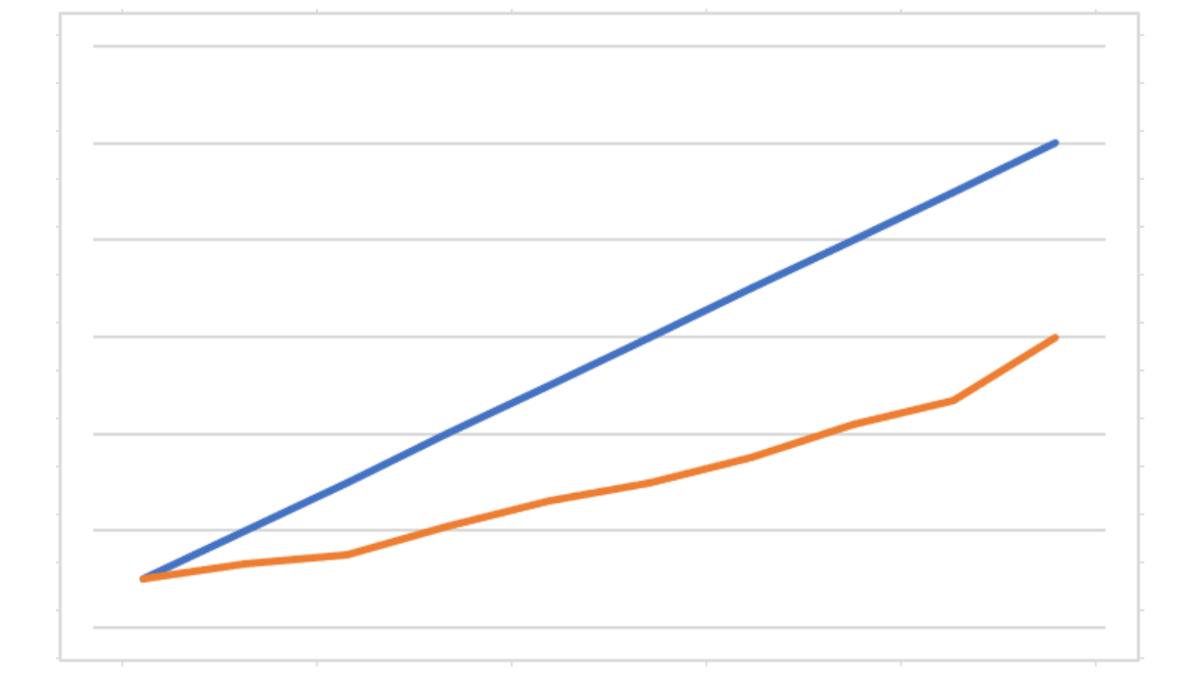
The relevant measurement question is therefore not how much communication a prospect receives, but which nurturing paths demonstrably correlate with pipeline progression. This requires CRM integration, consistent definitions of lifecycle progression, and sufficiently long measurement periods to distinguish noise from structural change. A rising engagement score is not evidence of success in itself when prospects do not subsequently qualify faster or Opportunities do not convert more effectively.
The existing chart must be interpreted precisely from that perspective. The lower line represents a situation in which progression remains erratic and heavily dependent on ad hoc interactions. The upper line represents a process in which timing, qualification, and handoff have been organized more consistently. The relevant difference is therefore not more communication, but better-organized progression. When nurturing is measured in this way, its contribution can be discussed in terms that are also relevant to Sales management and executives.
Operational Friction Becomes Visible at the Handoff to Sales
The transition between Marketing and Sales is the moment when the quality of the nurturing model is truly tested. In theory, this transition appears straightforward: a prospect reaches a status and Sales takes over the follow-up. In practice, this is precisely where most friction arises because score, account fit, timing, and local Sales capacity do not always point in the same direction. When the model does not make these factors sufficiently explicit, hesitation emerges and leads are followed up selectively or handled outside the formal process.
That friction increases when multiple regions use different interpretations of lead quality. A central score can technically be identical everywhere while its commercial meaning differs by market. This undermines not only follow-up, but also international reporting because the same status no longer represents the same probability of progression. An enterprise model must therefore define which criteria are universal and where local Sales context can legitimately play a role, without those exceptions becoming invisible.
A prospect is only truly sales-ready when the criteria behind that status are recognizable to Sales and retain the same commercial meaning within the context in which follow-up takes place.
When Marketing and Sales use the same decision logic, the transition changes from a handoff into a controlled progression. Sales receives not only a lead, but also context explaining why follow-up is justified at that moment. Marketing subsequently receives structured feedback on acceptance, rejection reasons, and further pipeline progression. That feedback should flow back into scoring and journey logic so that the model improves based on structural outcomes rather than incidental opinions.
Nurturing Also Influences Forecasting and Commercial Management
Weak nurturing has consequences that extend beyond Marketing performance. When leads are qualified inconsistently, handoff moments vary, and follow-up remains dependent on individual interpretation, pipeline becomes less predictable. Sales management then has more difficulty determining how much commercial progression is genuinely being generated by Marketing and which volumes can realistically be expected to convert into Opportunities. Forecasting becomes more defensive because the transition from engagement to pipeline is not stable enough to inspire confidence.
A well-designed nurturing model improves forecasting not because it perfectly predicts future revenue, but because the path toward Sales becomes more consistent. When lifecycle definitions, qualification, and feedback retain the same meaning over time, a more reliable basis for capacity planning and commercial prioritization emerges. Management can then better distinguish whether pipeline problems result from insufficient demand, weak qualification, poor follow-up, or an excessively long Sales cycle. This makes nurturing part of commercial management rather than solely a Marketing activity.
From Nurturing to a Governable Commercial System
Lead nurturing with Salesforce Account Engagement becomes enterprise-ready when data, scoring, journey logic, governance, and Sales handoff function as one coherent system. The number of campaigns or automations is not a measure of maturity. The relevant question is whether the organization can explain why a prospect has a particular status, why a next step is justified, and who is responsible when the outcome deviates from expectations. Without that coherence, complexity grows faster than control.
Organizations that do establish this discipline use nurturing to allocate commercial attention more effectively, deploy Sales capacity more selectively, and better understand progression through the buying process. Account Engagement supports this way of working by connecting signals, decision rules, and execution, but the quality of the model remains dependent on explicit organizational choices. Nurturing thereby definitively shifts from campaign to operating model: no longer a series of Marketing actions, but a governable structure that supports demand development, Sales alignment, and pipeline progression at scale.