


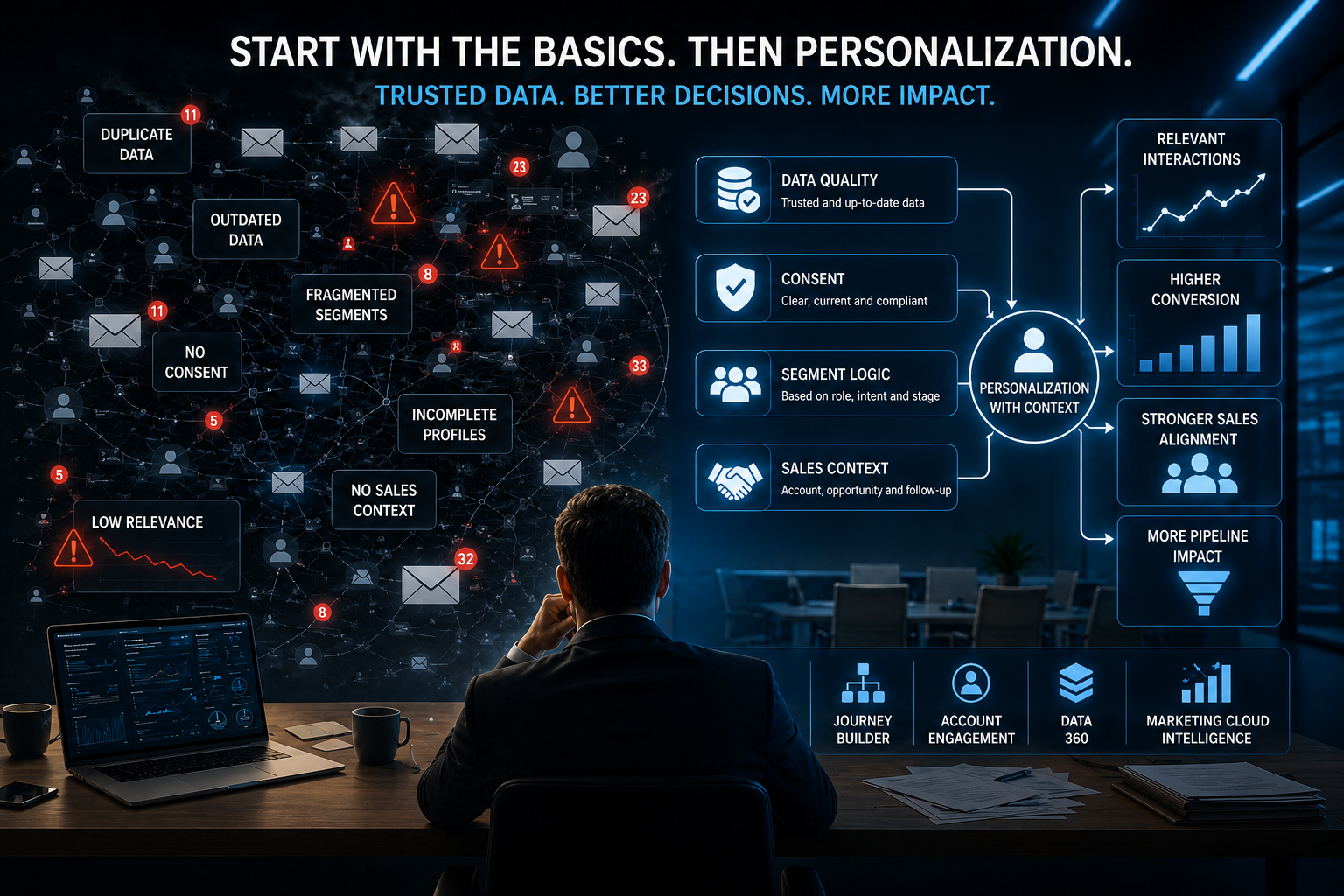
Automate B2B Personalization Only After Data Quality Is Reliable
B2B personalization is often automated too early. Organizations want to deliver more relevant communications faster, respond to behavior in real time, and automatically move prospects or customers through journeys. Salesforce Marketing Cloud, Journey Builder, Account Engagement, and Data 360 enable many possibilities, but technology does not solve the fundamental problem on its own. When data quality, consent, segmentation logic, and sales context are not yet sufficiently reliable, personalization is primarily executed faster, not better. That is precisely why real-time personalization often disappoints in B2B environments. The problem usually does not lie in the concept of personalization, but in the point at which it is automated. Teams build dynamic content, behavior-driven journeys, audience rules, and lead nurturing flows before the organization has sufficient control over data, decision logic, and commercial context. This produces messages that are technically personalized, but do not match the recipient’s stage, role, intent, or sales reality.Why Personalization Is Often Scaled Too Early
The pressure to personalize is understandable. Marketing teams want to demonstrate that they communicate more relevantly than they would through generic campaigns. Sales expects better signals and warmer leads. Management wants marketing automation to make a visible contribution to pipeline, revenue, and customer value. In that context, personalization is quickly treated as proof of maturity. The more segments, triggers, and dynamic variations are active, the more advanced the environment appears. That impression is misleading. Personalization is not a maturity layer that can be placed on top of an immature data model. It amplifies everything beneath it. Good data, clear consent, reliable segments, and explicit sales context become more valuable. Poor data, inconsistent segmentation, outdated account information, and unclear follow-up become more visible. Automation makes personalization scalable, but it also increases the damage when the foundation is unreliable.B2B personalization only creates value when automation does not move ahead of data quality, consent, segmentation logic, and sales context.
Real-Time Personalization Does Not Fail Because of Speed
Real-time personalization is often presented as a question of speed. Someone visits a page, clicks an email, downloads a document, or shows interest in a product category. The marketing environment must respond immediately. That sounds logical, but speed is rarely the most important success factor in B2B. A rapid response is only valuable when the interpretation of the signal is reliable. A download may mean that someone is in an early research phase, conducting internal research, comparing an existing vendor, collecting content for a colleague, or already speaking with sales. Without account context, role, lifecycle status, and previous interactions, behavior remains ambiguous. When automation responds only to the signal itself, real-time personalization becomes too mechanical. The organization responds quickly, but not necessarily appropriately. In B2B, correct interpretation is more important than the fastest response.Targeting Fails When Segmentation Logic Is Too Superficial
Targeting often appears simpler than it is. Teams segment by industry, job title, country, product interest, campaign source, or engagement score. These characteristics can be useful, but they rarely provide a sufficient basis for reliable B2B personalization. A CFO, operations director, and marketing manager within the same account may view the same content while having completely different interests. An enterprise account in the research stage requires different communication from a smaller customer with an active expansion need. Segmentation logic fails when it is primarily built around available fields rather than commercial meaning. Targeting then becomes technically executable, but strategically weak. Salesforce Marketing Cloud can activate segments, but it must be able to rely on the logic through which those segments were created. When that logic is missing, personalization is based on isolated characteristics. The message may appear more relevant, but it does not sufficiently reflect actual buying intent, account stage, and sales priority.Data Quality Is Not Merely a Technical Prerequisite
Data quality is often treated as a technical prerequisite in personalization projects. Are fields populated? Are values standardized? Are duplicates limited? Are integrations available? These are important questions, but for B2B personalization, data quality is also a commercial governance issue. The organization must determine which data is sufficiently reliable to automate decisions and which data should only be used as an indicator. When a job title, industry code, lead score, account status, or product interest is unreliable, that data should not automatically determine personalization. Otherwise, the recipient receives communication based on an incorrect profile, outdated status, or misinterpreted signal. Data quality is then no longer only about database hygiene, but about decision logic. Which data may initiate a journey? Which data may modify content? Which data may activate sales follow-up? Without that governance, personalization becomes vulnerable.Consent Determines the Scope of Personalization
Consent management is a second foundational layer that is often underestimated. Personalization requires the organization to understand not only what it can technically do, but also what it is permitted to do and through which channel. In B2B environments, consent is often more complex than a single opt-in or opt-out. It includes channel preferences, regional requirements, local interpretations, existing customer relationships, event communications, commercial follow-up, and differences between marketing and sales contact. When consent is not configured precisely enough, uncertainty arises within personalization. Teams do not always know whether a contact may enter a journey, whether dynamic content based on behavior is appropriate, whether a channel may be used, or whether sales follow-up is separate from marketing activation. As a result, personalization becomes either too cautious or too risky. A mature Salesforce Marketing Cloud environment makes consent part of personalization logic rather than treating it only as a legal check afterward.Which Foundations Must Be in Place Before Automation
Before B2B personalization is automated, the organization must determine whether the underlying logic is reliable enough to activate at scale. This does not require an endless preparation phase, but it does require explicit decisions about the foundation on which personalization may operate:- Data quality must be sufficiently reliable for the fields that determine segmentation, journey entry, dynamic content, and sales follow-up.
- Consent must clarify which channels, interactions, and forms of personalization may responsibly be used for each contact and region.
- Segmentation logic must be based on commercial meaning, including role, account stage, buying intent, lifecycle status, and priority.
- Sales context must be available so that marketing automation does not activate communications that conflict with active follow-up, opportunity status, or account strategy.
Sales Context Makes B2B Personalization More Specific
B2B personalization differs fundamentally from simple consumer personalization. The decision is often not made by one individual, but by multiple stakeholders. A contact may collect information, influence, compare, purchase, manage, or distribute information internally. The commercial meaning of behavior depends on the account relationship, opportunity status, sales stage, partner structure, and previous conversations. Without that context, personalization quickly becomes too generic. Sales context helps interpret the same behavior differently. A white paper download by an unknown prospect may initiate an early-stage nurture flow. The same download by a contact within an active opportunity may constitute a signal for sales. A click from an existing customer may indicate expansion, a support need, or renewed interest. Salesforce Marketing Cloud must be able to use this context. Otherwise, marketing automation risks disrupting sales rather than strengthening it.Account Engagement and Marketing Cloud Must Retain Clear Roles
In many B2B organizations, Account Engagement and Salesforce Marketing Cloud operate alongside one another. Account Engagement is often used for lead nurturing, forms, scoring, grading, and sales-oriented follow-up. Salesforce Marketing Cloud supports broader journeys, customer communications, segmentation, and multichannel activation. Personalization becomes problematic when both environments interpret signals and activate follow-up independently. It must therefore be clear in advance which environment takes the lead during each stage. Account Engagement can be highly effective for B2B lead qualification and sales alignment, while Salesforce Marketing Cloud can manage broader lifecycle communications and customer relationships. When that division of responsibilities is not explicit, prospects can enter overlapping flows. They then receive technically personalized communications based on multiple forms of logic, without the organization centrally governing which message has priority.Why Dynamic Content Is Often Introduced Too Quickly
Dynamic content appears to be a logical first step toward personalization. Teams can display variations by industry, role, interest, region, or lifecycle stage. This produces a visible result and feels less disruptive than full journey automation. Dynamic content can nevertheless also be introduced too early. When segments are incorrect, the wrong variation is displayed. When data is outdated, personalization feels strange. When consent and context are missing, the message may unintentionally become too specific or irrelevant. The risk is that dynamic content primarily creates cosmetic personalization. The header, introduction, or call to action changes, but the underlying customer logic remains the same. In B2B, that is often insufficient. Personalization should not merely display a different text variation. It should align more effectively with decision-making, account stage, commercial need, and follow-up. Dynamic content is valuable when it is powered by reliable segmentation logic. Without that foundation, it becomes a visual layer on top of an unclear model.Where Personalization Must Be Governed Within Salesforce
Personalization affects multiple layers within the Salesforce environment. It is not only a Journey Builder issue and not only a content issue. It affects CRM data, Account Engagement, Data 360, consent management, segmentation, governance, reporting, and sales processes. Personalization must therefore be governed as an architectural layer. Only then can the organization prevent each team from applying its own rules for targeting and real-time activation.| Foundation Layer | Governance Question | Risk of Premature Automation | Meaning for B2B Personalization |
|---|---|---|---|
| Data Quality | Which data is reliable enough to govern personalization? | Incorrect profiles result in incorrect content, segments, and journeys. | Personalization is based on validated fields and explicit ownership. |
| Consent | Which communications and channel activations are permitted? | Personalization becomes legally or operationally uncertain. | Consent determines the scope for real-time activation and dynamic content. |
| Segmentation Logic | What commercial meaning does an audience or behavioral signal have? | Targeting is built from isolated characteristics without strategic meaning. | Segments connect role, lifecycle status, account stage, and buying intent. |
| Sales Context | Which follow-up, opportunity status, or account strategy is already active? | Marketing automation conflicts with sales or activates too early. | Personalization strengthens sales alignment rather than creating noise. |
Real Time Only Creates Value with Decision Logic
Real-time personalization becomes stronger when it does not merely respond, but makes decisions. This requires decision logic. The organization must determine which signals carry significant weight, which signals are only supportive, and which signals justify action only when multiple conditions occur together. A single website click is often insufficient. A combination of account fit, role, repeated behavior, lifecycle status, and sales context may be sufficient. Without decision logic, real-time personalization becomes too trigger-driven. Every relevant action may then produce a response, but the system has insufficient understanding of why that response is valuable. Decision logic creates a distinction between interest, intent, priority, and follow-up. This makes personalization easier to explain to marketing, sales, and management. It also prevents dashboards from primarily showing that substantial activation is occurring without proving that the correct activation is occurring.Measuring Whether Personalization Truly Adds Value
Many personalization projects are evaluated based on engagement. Teams examine clicks, conversions, time on page, form interaction, or email response. These figures are useful, but insufficient. A personalized message may generate more clicks without improving commercial quality. An audience variation may perform better, but primarily among contacts who were already known or already strongly interested. Personalization then appears successful while adding little additional decision value. The organization must therefore measure whether personalization leads to stronger stage progression, more effective sales follow-up, higher pipeline quality, better conversion to Sales Accepted Lead, shorter cycle times, or more relevant customer communication. This requires connections between marketing data, CRM statuses, and commercial reporting. Marketing Cloud Intelligence can add value when the underlying definitions are reliable. Without shared KPI logic, personalization remains primarily a channel optimization rather than evidence of marketing impact.Governance Prevents Personalization Sprawl
Once personalization begins to work, the tendency to create more variations quickly emerges. More segments, more rules, more dynamic content, more journey paths, and more exceptions. This may appear logical, but without governance it creates personalization sprawl. The environment becomes more complex, the management burden increases, and it becomes more difficult to explain why someone receives a particular communication. At that point, the reliability of personalization begins to decline. Governance must determine who may add new segmentation rules, which data ownership is required, how consent is controlled, how variations are tested, and when personalization rules are removed. It must also be clear which personalization is governed centrally and where local teams have flexibility. This preserves scalability without allowing every country, team, or campaign to build its own interpretation of targeting and customer logic.The Correct Sequence for B2B Personalization
The correct sequence does not begin with automation, but with validation. First, the organization must establish which customer and account data is reliable. Consent must then be translated into practical channel and activation rules. Segmentation logic must subsequently be configured around commercial meaning. Sales context must then be connected so that marketing automation accounts for follow-up, opportunity status, and account priority. Only after these steps is the automation of personalization responsible. This sequence is important for Salesforce Marketing Cloud organizations because the platform enables many possibilities. The temptation to activate those possibilities immediately is significant. Real-time triggers, dynamic content, journey splits, and AI support can be implemented quickly. Technology, however, primarily accelerates the selected logic. When that logic is immature, technology accelerates errors. When the logic is reliable, automation can make personalization scalable and measurable.Personalization as the Result of Architecture
Mature B2B personalization is not a separate marketing project. It is the result of a properly designed architecture. Data, consent, segments, sales context, journeys, reporting, and governance must collectively determine which communication is relevant, permitted, explainable, and measurable. Salesforce Marketing Cloud can make this activation scalable, but value originates in the quality of the underlying decisions. It is therefore often advisable to automate personalization later than teams initially prefer. This is not excessive caution, but strategic discipline. Organizations that first establish data quality, consent, segmentation logic, and sales context prevent real-time personalization from becoming a fast but superficial layer. They build not only personalized communication, but a governable system for relevant B2B customer interaction. The central point is that B2B personalization does not fail because personalization itself is incorrect. It fails when automation is introduced too early. The organization must first determine which data is accurate, which communications are permitted, which segments have meaning, and which sales context is authoritative. Salesforce Marketing Cloud can then automate personalization in a way that not only communicates faster, but demonstrably supports better commercial decision-making.Deep-Dive Topics within Salesforce Marketing Cloud:
How Data 360 Makes B2B Personalization Reliable

Customer profiles create value only when data is reliable, complete, and operationally usable across marketing automation and commercial processes.
Why Consent Creates Clear Boundaries for B2B Personalization

How consent management prevents personalization from being activated when it is technically possible but legally or commercially inappropriate.
Why Segmentation Must Be
Rebuilt Before B2B Personalization

How weak segmentation causes B2B personalization to become misaligned, even when the underlying automation is technically sound.