



Why Salesforce Marketing Cloud Integrations Can Fail Unexpectedly — and How to Safeguard Continuity
A business-critical marketing environment does not have to visibly come to a halt to disrupt operations. Journeys can continue running, automations can execute according to schedule, and dashboards can appear to function normally while an essential data flow has already been interrupted in the background. In complex Salesforce Marketing Cloud Engagement environments, the real risk therefore often lies not in an obvious platform outage, but in an integration that silently stops receiving or processing current data.
That risk becomes particularly concrete in September 2026. Salesforce will allow existing client secrets for Installed Packages that have not been rotated since March 25, 2026, to expire on September 30. Newly generated and rotated secrets will then have a validity period of 180 days. What initially appears to be a technical security change therefore introduces a recurring management and continuity requirement for organizations that connect Marketing Cloud Engagement with CRM, middleware, data platforms, websites, applications, and other business systems.
For smaller and relatively straightforward implementations, replacing a client secret may be fairly simple. In an enterprise landscape, the situation is different. Integrations accumulated over many years may be distributed across multiple Business Units, vendors, and applications. It is not always immediately clear who owns them, which systems use the same credential, and which commercial processes depend on the data flowing through such an integration. This is precisely where a security measure becomes a governance issue.
The relevant C-level question is therefore not whether an administrator can generate a new secret before the deadline. The question is whether the organization has sufficient visibility into its Marketing Cloud integration landscape to execute such a change in a controlled way without unintentionally disrupting customer communications, lead processes, reporting, or other commercial activities.
A Technical Change Can Expose a Commercial Continuity Risk
Client secrets are used to allow applications to authenticate securely and gain access to API functionality. As a result, they are easily treated as part of technical administration. However, the business value behind such a credential is often much greater. The same authentication can support the delivery of customer data, updates to lead statuses, the exchange of campaign information, or datasets that are subsequently used by Automation Studio and Journey Builder.
If authentication fails, Marketing Cloud Engagement itself does not necessarily have to be unavailable. An external application may stop supplying new data while existing automations continue to run as scheduled. A campaign may still execute, but with an incomplete audience. A journey may remain active while new contacts no longer enter it. Reporting may remain accessible while the underlying dataset is no longer being fully updated.
The risk arises precisely because the technical cause and the business impact can be separated by several steps. The technical failure occurs at the authentication layer, while the visible consequence may emerge later in campaign performance, customer journeys, lead management, or management information. Teams responsible for different parts of the same chain can therefore each conclude that their own component is operating correctly.
For management, this is an important distinction. Platform availability is not the same as business process continuity. An enterprise Marketing Cloud environment consists of far more than the Salesforce components visible on screen. Actual service delivery depends on the entire chain of sources, APIs, integration layers, data flows, automations, and downstream processes. A weakness in any one of those connections can therefore have a disproportionately large impact.
The Greatest Risk Often Lies in Dependencies No One Fully Understands
Most enterprise environments are not designed in a single phase. They evolve over many years, are expanded by different implementation partners, and gain new integrations as business models, technology, and data requirements change. This creates a landscape in which technically well-functioning integrations are not necessarily well documented. An Installed Package may have been created years ago by an employee or vendor who is no longer involved, while the integration itself still supports an important business process every day.
Periodic secret rotation therefore also becomes a test of integration management maturity. An organization that can quickly determine which applications use an Installed Package, who owns it, and which processes will be affected by a change has its architecture under governance control. If that information first has to be reconstructed from old documentation, scripts, vendor knowledge, and individual employees, a different picture emerges. The technical landscape may work, but it remains organizationally vulnerable.
That vulnerability can remain largely invisible under normal circumstances. As long as a credential continues to work indefinitely, there is little operational reason to revisit an old integration. A mandatory lifecycle breaks that pattern. Every rotation requires renewed knowledge of how the credential is being used and forces the organization to periodically determine whether its documented landscape still reflects reality.
The most vulnerable integration is not necessarily the technically weakest connection, but the one for which no one can clearly explain which business processes depend on it.
This perspective also makes clear why the issue does not belong exclusively to IT or Marketing Operations. The value of the integration ultimately exists within a business process. If a connection is critical to lead generation, transactional communications, customer segmentation, or commercial reporting, its continuity should be assessed with the same risk discipline applied to other digital processes on which revenue and customer service depend.
From Credential Management to Governable Integrations
A mature approach therefore begins not with the question of which secrets are about to expire, but with the question of which integrations are genuinely business-critical. The expiration date is an important technical fact, but it says nothing about the impact of an outage. Two Installed Packages may require a new secret on the same day, while one supports a limited internal utility and the other forms part of a data flow that influences millions of customer interactions every day.
Technical configuration must therefore be connected to business context. For every relevant integration, the organization should understand not only which Installed Package and client application are being used, but also what function the integration performs, which processes depend on it, and who is responsible when changes are required. Only then can priorities be based on business impact rather than technical urgency alone.
This does not necessarily require a new layer of governance or a separate administration specifically for Marketing Cloud. It is more effective to incorporate relevant integrations into existing processes for architecture, configuration management, change management, and risk management. Within an enterprise environment, Marketing Cloud Engagement is not an isolated marketing tool. It forms part of a broader technology ecosystem in which customer data, communications, and commercial decision-making are interconnected.
Lifecycle management belongs within that model as well. Because new client secrets have a 180-day validity period, replacing them becomes a recurring process. A one-time inventory in September therefore achieves little if the same information has to be gathered again six months later. Ownership, dependencies, and expiration dates must remain current and become part of regular management.
The change can therefore act as a useful catalyst. Organizations gain a concrete reason to determine which packages are still genuinely in use, where historical dependencies have developed, and which integrations are insufficiently documented. Old or redundant connections can be investigated, while business-critical integrations can be brought more explicitly under management. Security therefore does more than create a new technical obligation; it can also improve the quality of the integration landscape.
Rotating Secrets Without Disrupting Commercial Processes
Salesforce supports a staged rotation process for OAuth 2.0 integrations. A new client secret can first be generated while the existing secret remains active. Applications using the Installed Package can then be migrated to the new secret and tested. Once the clients have been confirmed to operate correctly, the new secret can be activated and the previous secret revoked.
This mechanism enables a controlled transition and reduces the need for downtime. However, the technical capability alone does not guarantee continuity. If the organization does not know which applications use the package, a forgotten client may fail only after activation. The staged process is therefore most effective when dependency management and change management are already in place.
The testing approach also requires attention. Successful authentication proves that an application can connect using the new secret, but it says little about the complete business function. A data flow can be technically successful while records arrive incomplete, volumes deviate, or downstream processes fail to receive the same output as before the change. For business-critical integrations, validation must therefore go beyond the technical API call.
This means that IT and Marketing have different but complementary responsibilities. Technical teams can establish whether authentication, connectivity, and data transfer function correctly. The owner of the business process must determine whether the commercial outcome remains correct. A journey that is active is not automatically a healthy journey; an automation that completes successfully does not prove that its input was complete.
The same applies to monitoring after activation. Some integrations authenticate continuously, while others do so only during scheduled batches or specific processes. An error may therefore not become visible immediately after the change. The observation period should reflect the normal usage cycle of the integration and the potential impact if data is missing or processes are delayed.
Governance Determines Whether a Security Measure Also Delivers Continuity
The new secret lifecycle affects responsibilities that are distributed across different functions in many organizations. Security focuses on protecting credentials and limiting unauthorized access. IT manages platforms, integrations, and technical changes. Marketing Operations oversees campaigns, journeys, and data-driven processes. External vendors may meanwhile own applications in which the new secret ultimately has to be implemented.
Such a division is not inherently problematic. The risk arises when responsibility for the complete chain is not explicitly assigned anywhere. Every party can manage its own component correctly while no one is responsible for determining whether the end-to-end business function still works after a change. For C-level governance, that final question is the decisive one.
A mature control model therefore connects technical responsibility with business responsibility. Management does not need to know how a client secret is generated, but it should be able to rely on clear accountability for critical integrations: who executes the change, who understands the business impact, who validates the outcome, and who acts when monitoring reveals an anomaly. The key differences between reactive management and enterprise governance then become visible:
| Governance Question | Reactive Management | Enterprise Approach |
|---|---|---|
| Dependencies | Investigated when a change becomes necessary | Mapped in advance to applications and business processes |
| Ownership | Distributed across teams and vendors | Technical and business accountability are explicit |
| Priority | Determined by the next technical deadline | Determined by business impact and continuity risk |
| Validation | Primarily checks whether the connection works again | Validates the complete end-to-end business function |
| Lifecycle | Each rotation is organized again from scratch | Rotation forms part of a structured control and change process |
That governance alignment is particularly important in international organizations with multiple Business Units. Salesforce provides greater visibility into the expiration and status of Installed Packages, but platform information cannot determine which internal department or vendor is accountable for the business consequences of a change. Technology can signal that action is required; governance determines whether that action is carried out on time and in full.
From a September Deadline to a Structural Operating Model
The first major deadline of September 30, 2026, is therefore less important than it initially appears. Organizations must of course prevent existing unrotated secrets from expiring automatically and interrupting integrations. But an organization that focuses only on this date is treating a structural change as a one-time project. After every successful rotation, a new 180-day lifecycle begins.
A mature organization therefore shifts from deadline management to lifecycle management. Expiration dates are identified in time, but preparation begins well before expiration becomes urgent. Ownership is reconfirmed, changes in the landscape are reviewed, and relevant vendors receive sufficient time to update their applications. Rotation can then be incorporated into the normal change cycle rather than executed under pressure shortly before a credential expires.
This recurring cycle has broader value as well. Every review creates an opportunity to determine whether an integration is still necessary, whether the responsible teams remain the same, and whether new dependencies have emerged. Secret rotation therefore becomes part of a recurring quality control process for the integration landscape. What began as a security measure also supports architectural discipline and operational manageability.
For executives and senior management, this connects to a broader issue surrounding marketing technology. Many organizations have invested heavily in more data, greater automation, and more integrated customer engagement in recent years. Their dependence on the underlying technology landscape has increased at the same time. The maturity of Marketing Cloud cannot therefore be measured solely by the number of journeys, automations, or data sources available. Equally important is the extent to which the organization understands and governs the dependencies behind those capabilities.
A scalable Marketing Cloud operating model therefore combines innovation with control. New integrations can create value relatively quickly, but they should have clear ownership, documentation, and a defined lifecycle from the outset. Security changes should be executable without first having to reconstruct historical knowledge. And when a critical credential is replaced, it should already be clear which processes must demonstrably continue to function afterward.
Integration Continuity Is Ultimately a Management Issue
The introduction of client secret expiration makes a previously hidden aspect of Marketing Cloud Engagement suddenly visible. The immediate task is technical: rotate existing secrets in time and account for their limited lifespan going forward. The strategic task is broader. Organizations must ensure that critical marketing integrations are not only technically operational, but remain governable when credentials, platform requirements, vendors, or architectures change.
That is where the real relevance lies for C-level stakeholders. Marketing technology increasingly supports processes directly connected to customer experience, revenue, compliance, and management information. Integration continuity is therefore not a detail of the administration function, but part of digital business continuity. Management does not need to manage the technology itself, but it must be able to rely on an operating model in which risk, ownership, and control are demonstrably addressed.
Organizations that treat the upcoming rotation exclusively as a technical maintenance task may meet the next deadline, but they will change little about their structural vulnerability. Organizations that use the moment to reorganize dependencies, ownership, and lifecycle management are instead building a Marketing Cloud landscape that is better able to withstand future platform and security changes.
CloudEngagePro supports organizations in connecting Salesforce Marketing Cloud Engagement with the broader enterprise architecture, data organization, and governance model. The focus is not only on the technical configuration of an integration, but also on how Marketing, IT, and other stakeholders collectively ensure scalability, control, and continuity. That alignment ultimately determines whether a Marketing Cloud environment remains sustainably manageable at enterprise scale.
Deep-Dive Topics within Salesforce Marketing Cloud:
How Salesforce Integrations Reliably Connect Commercial Processes Across the Enterprise
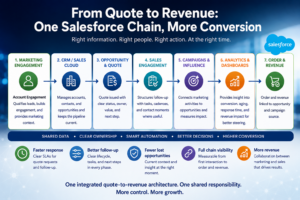
A connected Salesforce architecture must do more than exchange data between platforms. This article explains how integration governance, dependency management, ownership, and controlled data flows keep Marketing, Sales, and enterprise systems aligned as processes become more complex and business-critical.
Why Lifecycle Governance in Salesforce Account Engagement Determines Scalability
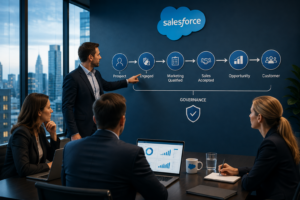
Lifecycle governance defines who owns each stage, when responsibility transfers, and which conditions determine progression or exclusion. Clear lifecycle definitions prevent Marketing and Sales processes from becoming dependent on informal handoffs, conflicting interpretations, and exceptions that become increasingly difficult to control at scale.
How Revenue Operations Turns Salesforce Data into Predictable Commercial Decision-Making

Revenue Operations creates a shared commercial operating model by connecting data, processes, responsibilities, pipeline, and revenue definitions across teams. This article shows how Salesforce can support more predictable decision-making when Marketing, Sales, and management work from consistent metrics, governed data, and clearly defined ownership.