


From Quote to Revenue: How Salesforce Components Work Together to Strengthen B2B Conversion
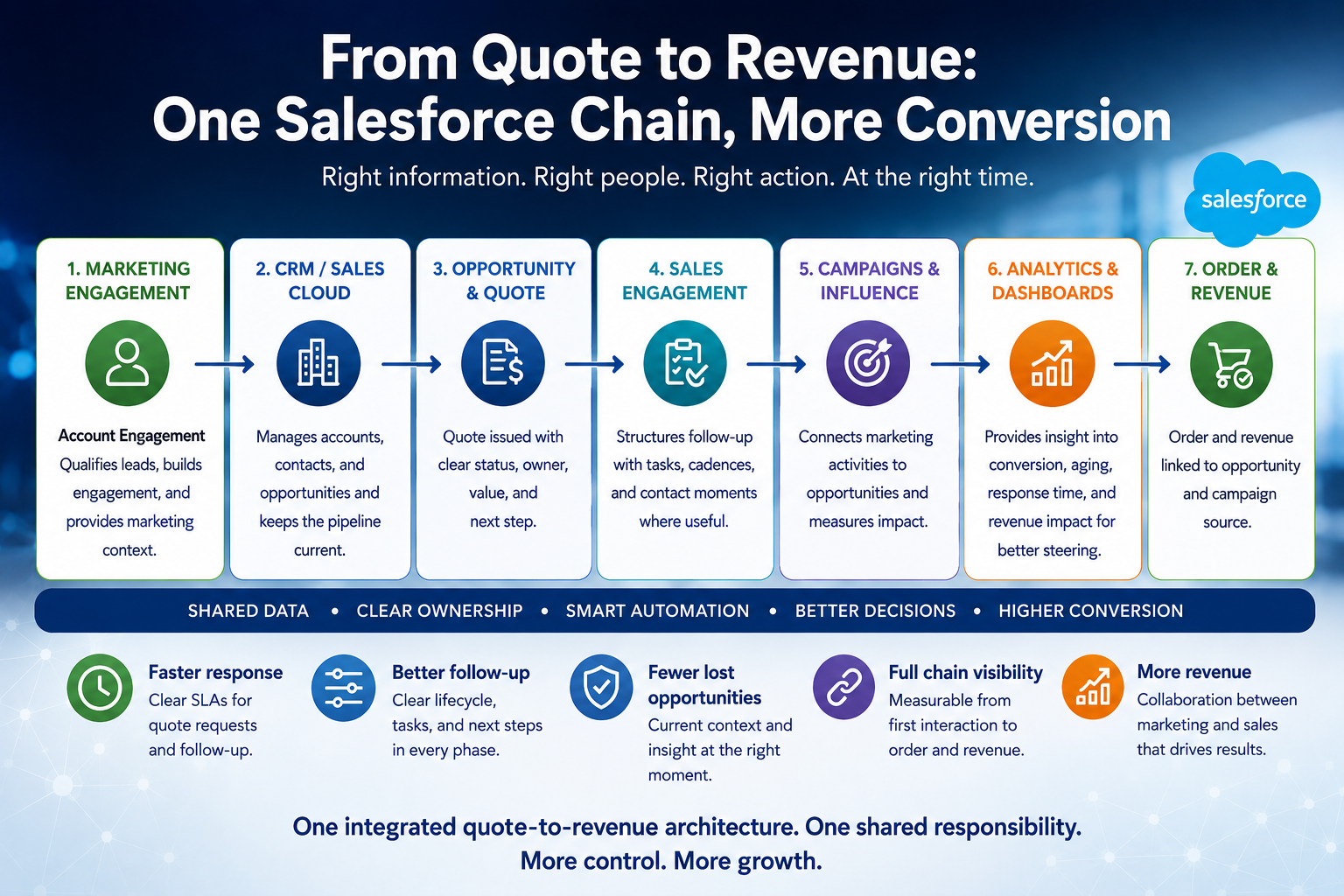
A quote is not an endpoint in complex B2B sales, but the beginning of a new commercial stage. Marketing has built context, Sales has made a concrete offer, and from that moment onward it must remain clear who is responsible, which next step has been agreed, and how the Opportunity ultimately progresses to Order and revenue. This is precisely where gaps emerge in many organizations: marketing information becomes disconnected from the sales process, follow-up differs by account manager, and management only sees afterward which opportunities have actually converted. As a result, potential revenue can remain open longer than commercially desirable, without one shared view of the underlying cause. Salesforce provides the components to make this transition much more manageable when Marketing Cloud Account Engagement, Salesforce CRM, Campaign Influence, Sales Engagement, and reporting are configured as parts of one commercial chain. Not every component needs to perform every function. The strength lies precisely in a clear division of responsibilities, with Account Engagement supporting marketing context and qualification, Salesforce CRM governing formal commercial progress, and additional Salesforce functionality supporting follow-up, attribution, and management. This creates not a collection of disconnected automations, but a coherent process from inquiry to realized revenue. The strongest conversion therefore does not result from maximizing automation. It results from a functional architecture in which quote requests are assigned quickly, active quotes receive an explicit status, marketing communications align with the current sales stage, and the relationship between Campaign, Opportunity, Quote, Order, and revenue remains intact. This turns the progression from quote to order into a manageable process rather than a series of disconnected actions.Quote Conversion Starts Before the Quote Is Sent
A reliable quote-to-revenue chain does not begin when a PDF containing pricing and terms is sent. By that point, the commercial context has already been built from source information, Campaign relationships, Contact and Account data, qualification, and the Opportunity that precedes the quote. When that information is lost along the way or interpreted differently, it becomes impossible to determine reliably later which marketing activity, channel, or commercial intervention contributed to the eventual revenue. Marketing Cloud Account Engagement can provide context during the earlier stage through forms, tracking, scoring, grading, and nurturing. This information helps distinguish between general engagement and prospects that are sufficiently relevant for commercial follow-up. Once Sales accepts the lead and further develops an Opportunity, however, that context must remain part of the same Salesforce data chain. A handoff is only mature when not only a name and email address are transferred, but also the source, qualification, Campaign relationship, and relevant commercial context are retained. Speed also plays a role before the quote is issued. A new qualified inquiry requires different process rules from an Opportunity that has already been open for months. For new inquiries, ownership, routing, and response time must therefore be explicitly configured. Otherwise, an organization can have advanced nurturing and analytics while a concrete commercial inquiry still remains stuck in a mailbox, manual list, or unclear queue.Each Salesforce Component Has a Clear Responsibility
A robust quote-to-revenue architecture prevents the same responsibility from being configured in multiple places. Account Engagement should not independently determine whether a quote is still commercially valid, and Salesforce CRM should not have to reconstruct how an Opportunity originated without marketing context. Campaign Influence can only provide usable attribution when the underlying Campaign, Contact, and Opportunity relationships are correct. By defining the role of each Salesforce component, a clearer process emerges for Marketing, Sales, and management.| Salesforce Component | Primary Role Within the Commercial Chain | Commercial Outcome |
|---|---|---|
| Marketing Cloud Account Engagement | Lead qualification, nurturing, scoring, grading, and marketing context | Better preparation and timing of commercial handoff |
| Salesforce CRM / Sales Cloud | Accounts, Contacts, Opportunities, Quotes, ownership, and commercial status | A current and manageable pipeline |
| Salesforce Campaigns & Campaign Influence | Connect Campaigns to Opportunities and commercial outcomes | Better revenue attribution and campaign evaluation |
| Sales Engagement | Structured tasks and follow-up processes where standardization is appropriate | Less dependence on individual working methods |
| B2B Marketing Analytics and Salesforce dashboards | Combine campaign, pipeline, conversion, and revenue information | Shared management by Marketing, Sales, and management |
| Marketing Cloud | Additional multichannel orchestration when the Customer Journey requires it | Consistent communication across multiple channels |
An Issued Quote Must Become an Explicit Commercial Stage
In many organizations, a gray area emerges after a quote has been sent. The Opportunity remains open, but the exact status of the quote, the agreed next step, and responsibility for the next contact are not always recorded with equal clarity. As a result, an account manager may work from personal notes while Marketing only sees that a Contact is still included in a particular segment. For manageable conversion, an active quote must therefore be recognizable as an explicit commercial stage within the process. This stage does not require every organization to use exactly the same Opportunity Stages or Quote Statuses. The definitions do, however, need to be unambiguous: when is a quote considered issued, when is it under discussion, when is Sales waiting for the customer, when is additional information required, and when has the opportunity effectively stalled? Without these agreements, quote aging becomes a rough measure of time that says little about the actual commercial situation. With clear statuses, management can distinguish between normal cycle time and Opportunities that require attention. The status also has implications for Marketing. A prospect with an active quote should not automatically receive the same nurture communications as someone who is still in an early orientation stage. Based on reliable CRM statuses, Account Engagement can pause, suppress, or adjust regular communications when the commercial context requires it. After Closed Won, Closed Lost, or an explicitly deferred stage, it can then be determined again which marketing communication is appropriate.An active quote changes not only the status in Sales. It also changes the context within which Marketing can communicate responsibly.
Fast Response and Long-Term Follow-Up Require Different Rules
Not every quote context requires the same speed or the same action. For a new qualified inquiry, rapid assignment is often essential: the prospect expects a response, and unnecessary delay can directly affect whether a conversation is established at all. For an already issued quote, the question is different. The primary concern is not speed since the latest digital signal, but the agreed commercial next step, the current decision date, and the reason the Opportunity remains open. Organizations must therefore distinguish between response time and quote aging. Response time measures how quickly a new commercial trigger is addressed. Quote aging shows how long a quote remains in a particular stage, but only becomes meaningful when the underlying status and next step are reliable. A quote that has been open for six months in a project with a planned investment decision nine months away is very different from a quote that has remained in the same status for six weeks without an owner or follow-up action. Salesforce can make these differences visible and manageable without every delay automatically triggering an external message. An exceeded response time can, for example, activate an internal escalation or task, while long-running Opportunities can be reviewed periodically for status, close date, and next step. Automation is then used to support process discipline rather than to approach prospects mechanically according to a single timeline.Sales Engagement Can Add Structure Without Replacing Account Management
With large numbers of Opportunities, Sales Engagement can help make follow-up more consistent. Cadences, tasks, and prioritization can make account managers less dependent on personal reminders or separate calendar items. This is particularly useful when certain process steps are repeatable and the commercial team has clear agreements about what should happen at each stage. That standardization must, however, fit the nature of the sales process. In complex B2B engagements, quotes can differ significantly in value, technical complexity, decision-making, and cycle time. A fixed cadence that approaches every Opportunity in exactly the same way after exactly the same period can therefore be counterproductive. Sales Engagement should add structure to the account manager’s work, not take over the substantive assessment of an account. A strong configuration distinguishes between internal actions and external communication. A task to review an Opportunity is different from automatically sending an email to the prospect. Particularly in long sales cycles, an internal review step can be valuable: is the close date still accurate, has the next step been recorded, is the quote still current, and is additional involvement from Marketing required? This improves both data quality and commercial discipline without placing unnecessary pressure on the customer.Campaign Influence Keeps Marketing’s Contribution Visible Through Revenue
When Marketing reports only through lead generation, a substantial part of its commercial value remains invisible. The relevant question is ultimately not only how many leads or form submissions a campaign generated, but which campaigns contributed to Opportunities, quotes, won deals, and revenue. Salesforce Campaigns and Campaign Influence can support this connection when the underlying relationships are recorded consistently. For this to work, source information must survive lead conversion and later Opportunity stages. Contacts must be connected to Campaigns where relevant, Opportunities must contain the appropriate Contact Roles and Campaign relationships, and the organization must determine which attribution logic it uses. Without that foundation, a dashboard may be technically impressive but commercially misleading. Reliable revenue attribution therefore begins with the data model, not with visualization. B2B Marketing Analytics can then help analyze marketing and sales information together. Its added value lies primarily in making the relationship between engagement, Campaigns, pipeline, and revenue visible. Marketing can therefore be evaluated on commercial contribution rather than activity alone, while Sales and management use the same definitions when assessing pipeline quality and conversion.Opportunity, Quote, Order, and Revenue Must Remain Technically Connected
A quote-to-revenue process is only truly closed when the step after the won Opportunity is also reliable. A quote may be considered administratively successful while the final order value differs, is split, or is modified later. When Order and realized revenue become disconnected from the original Opportunity and Campaign context, commercial reporting remains incomplete. The relationship between Opportunity, Quote, Order, and revenue must therefore be an explicit part of the data model. Which Quote is leading? How is an accepted quote converted into an Order? Does the original Campaign information remain available? How are changes in order value processed? And which object or status ultimately serves as the reliable basis for revenue reporting? These questions are more important than adding another dashboard. In organizations with a complex Configure-to-Order process, this is particularly relevant. Salesforce can support not only the commercial CRM process, but also the transition to operational execution. In that situation, the marketing and attribution layer must not disrupt the existing order process. The architecture must align with the existing Salesforce core and ensure that commercial traceability is preserved while operational processes remain intact.Dashboards Must Show Where Conversion Slows Down
A management dashboard for quote conversion must go beyond total pipeline value. A large amount of open Opportunities may appear positive, but says little when a substantial portion remains open for months without a current next step. Management therefore requires KPIs that show not only volume, but also speed, progress, quality, and eventual revenue contribution. A useful dashboard can, for example, combine the following indicators:- average response time for qualified quote requests;
- conversion from Opportunity to Quote and from Quote to Order;
- average quote duration by sales stage or sales type;
- number of Opportunities without a current next step or responsible owner;
- average cycle time between quote, decision, and Order;
- pipeline and revenue contribution by Campaign, source, or partner channel;
- difference between quoted value, won Opportunity, and realized revenue.
Only Add Marketing Cloud and Data 360 When the Use Case Requires It
Not every quote-to-revenue architecture immediately requires additional Marketing Cloud functionality or Data 360. When the main problems lie in lead qualification, Opportunity statuses, quote management, Campaign Influence, and reporting, substantial value can already be created with Account Engagement, Salesforce CRM, and consistent commercial data modeling. Additional technology does not resolve unclear ownership or inconsistent process data. Marketing Cloud becomes more relevant when the organization requires broader multichannel orchestration alongside Account Engagement and wants to coordinate different communication channels centrally. Data 360 becomes more relevant when CRM data, website behavior, and multiple external data sources need to be unified into usable profiles and segments. Even then, the choice should be driven by a concrete use case rather than by the assumption that more platform components automatically create a better Revenue Operations architecture. The correct sequence is therefore to first determine where the commercial chain breaks, then restore the data model and responsibilities, and only afterward determine which additional Salesforce functionality is required. This keeps the architecture manageable and prevents a process problem from being masked by additional tooling.From Separate Salesforce Components to One Commercial Chain
Successful quote conversion ultimately requires more than strong sales follow-up. Marketing must build relevant context before an Opportunity is created, Sales must take over that context without information loss, and Salesforce must make clear throughout the quote stage who is responsible, which status is current, and what the next commercial step will be. The transition between Marketing and Sales therefore becomes not a separate handoff moment, but a controlled part of the same commercial chain. Marketing Cloud Account Engagement supports qualification and marketing context. Salesforce CRM remains the commercial system of record for Account, Opportunity, and Quote. Sales Engagement can structure follow-up, Campaign Influence connects Marketing with commercial outcomes, and reporting shows where the chain accelerates or slows down. Each component has its own function, but operates on the same commercial reality and the same definitions of progress. This turns the progression from quote to order from an isolated sales activity into a jointly manageable process. The greatest gain does not come from more automation, but from better collaboration between Salesforce components, clear responsibilities, and a data chain that remains intact from the first commercial context through realized revenue. It is precisely this coherence that makes it possible to respond faster to new inquiries, manage long-running open quotes more effectively, and structurally improve conversion.Deep-Dive Topics within Salesforce Marketing Cloud:
How Buying Intent Signals
Improve Quote Follow-Up
and Make It More Predictable
Buying intent becomes commercially useful when behavior, account context, Opportunity stage, and timing are interpreted together. These signals help Sales distinguish routine follow-up from moments that require targeted action to improve quote progression, responsiveness, and conversion.
Why Account Engagement Needs
Lifecycle Governance to Scale
Across Complex B2B Sales

Lifecycle governance creates explicit ownership, handoff criteria, and progression rules across Marketing and Sales. Clear statuses, responsibilities, and exception handling keep complex B2B processes scalable without losing commercial context as opportunities move from engagement toward quote and revenue.
How Reliable Revenue Data
Makes Salesforce Forecasting
Scalable and Enterprise-Ready

Reliable forecasting depends on consistent pipeline, Opportunity, and revenue definitions rather than disconnected reporting views. Governed commercial data gives leadership a stronger basis for forecasting, prioritization, and scalable decision-making across teams, markets, and reporting structures.